
Your Cart is Empty





In-Motion Parcel Dimensioning and Sortation: How Modern Outbound Systems Work

The fastest pack station in the building is the one where nobody picks a box
Walk the outbound side of a high-volume distribution center and you can usually spot the bottleneck without being told. It is the packer standing over an order, eyeing the contents, reaching for a box, second-guessing the size, taping it up, weighing it on a bench scale, and keying the weight into a screen. Every one of those motions is a decision, and every decision is time. Multiply it across thousands of orders a day and the cost is no longer measured in seconds. It is measured in headcount.
At Pitman Creek, a high-volume fishing and outdoor distributor, the packing floor has more than twenty pack stations and moves several thousand boxes a day during peak.
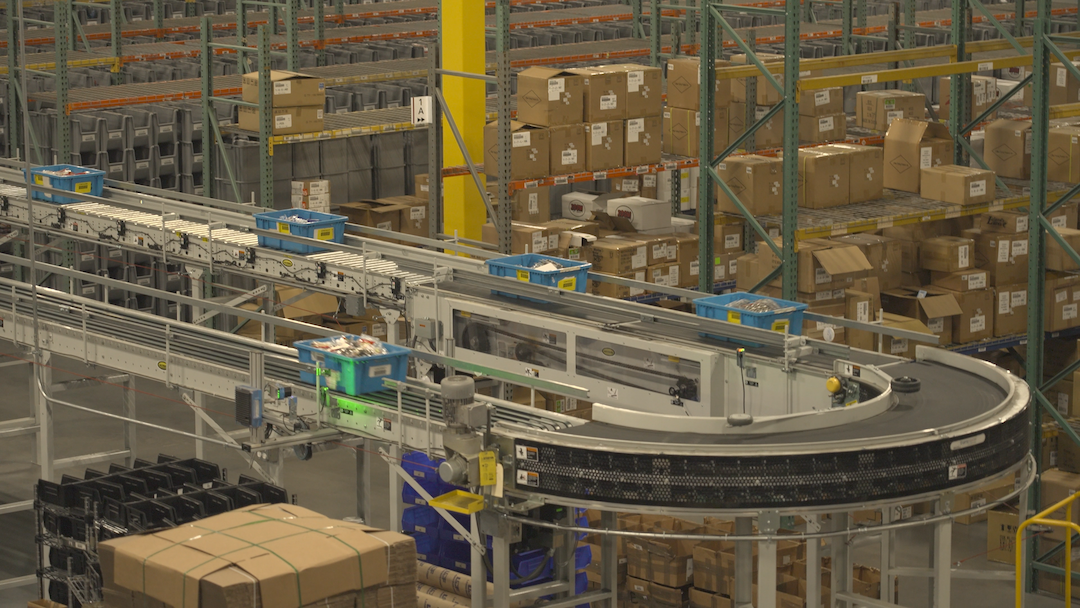
Pitman Creek runs a Hytrol conveyor and sortation system that we designed and installed, built around an in-motion parcel dimensioning system that measures, weighs, and labels every box on the move. When we walked the floor with their operations lead, the thing worth photographing was not the pack stations. It was what happened after the box left them. The packer never chose a box size, never weighed anything, and never touched a shipping label. The conveyor did all three.
Pitman Creek's operations lead walked us through the workflow plainly. At the pack station, the system prints two things: a license plate label (LPN) tied to the order, and a packing slip that goes inside the box. That is it. The box goes onto the conveyor, travels to an overhead scanning station the crew nicknamed the "Panda," and there it gets dimensioned, weighed, and labeled in motion, without stopping.
The moment that captures the whole design came when we watched a box reach the scanning station. "When they're at the pack station, they don't even need to tell the system or choose a box size," the operations lead explained. "They don't care, because this is going to do it for them." That sentence is the entire labor case in miniature.
That single design choice, moving dimensioning and labeling off the operator and onto the line, is the difference between an outbound operation that scales with volume and one that scales with hiring.
This piece walks through how a parcel dimensioning system works, what the technology can and cannot do, why the labeling step has become a dimensional weight cost control and not just a convenience, and the one question this operations lead kept asking that most buyers forget to ask: what happens when the single machine every box depends on goes down?
Table of Contents
-
What "in-motion" actually means
-
The numbers behind the magic trick
-
Removing the box-size decision is the labor story
-
The label is no longer a convenience. It is a cost control.
-
Sortation: one line, many destinations
-
The question the operations lead kept asking: where is the redundancy?
-
What modern outbound really looks like
What "in-motion" actually means
A dimensioner measures the length, width, and height of a package and pairs that with a weight. There are two ways to do it. A static dimensioner measures a package while it sits still, either on a measurement surface or held in front of a sensor array, and the operator moves it along afterward. An in-motion dimensioner measures the package while it travels down the conveyor, with the sensor array mounted above or around the belt, capturing each box as it passes at line speed with no stop and no operator involvement.
The distinction matters because it maps to volume. Static dimensioning fits most warehouse and 3PL pack stations and deploys in under an hour with no conveyor infrastructure. In-motion dimensioning earns its keep when you already have a conveyor and your throughput exceeds what a person at a station can feed, the realm of large distribution centers moving thousands of packages an hour on continuous lines.
Pitman Creek is squarely in that second category, which is why the in-line approach is the right one for them and would be overkill for a shop shipping a few hundred orders a day.
Mechanically, the most common high-accuracy approach projects a laser plane across the conveyor and watches, through a camera, how that line deforms as a package passes under it. Scanning thousands of times a second and reading conveyor speed from an encoder, the system reconstructs the full three-dimensional profile of the box.
LiDAR arrays do something similar by sweeping thousands of points across the package surface, and they tend to handle irregular and soft-sided items better than laser line scanners.
The system weighs each item with an in-motion scale, sometimes called a checkweigher, built into the same zone. That is the part that draws the most admiration on a tour, and understandably so. The operations lead described the unit the way most people react to it the first time:
"This particular camera system is a dimensioner. It determines the box going across and weighs it at the same time. It determines what the dimensions of that box is." Watching a box get weighed accurately while it is still moving feels like a magic trick. It is not. It is a well-calibrated load cell reading a moving belt, and it is the same principle that lets the line route a package the instant its data is captured.
The numbers behind the magic trick
Accuracy is where in-motion systems have to prove themselves, because the output feeds a carrier invoice. According to specifications published by dimensioning-system manufacturers, commercial laser line scanner systems rated for freight billing typically hold accuracy in the range of plus or minus two millimeters for packages moving up to roughly three meters per second, which covers the full speed range of most sortation conveyors including high-speed crossbelt and shoe sorters.
Vendors selling to the warehouse market generally cite sub-second capture and accuracy at or better than plus or minus two millimeters, which they describe as the threshold that meets carrier requirements and limits dispute exposure. These are vendor-published figures rather than independently audited benchmarks, so the right move for any buyer is to request accuracy test data for your own package profile before signing.
Two operational notes separate a system that works from one that quietly drifts.
First, calibration verification using a reference box of known dimensions should be run daily for billing-grade applications, because a system that is two millimeters off today can be more than that next month.
Second, performance on polybags, soft-sided parcels, and highly irregular shapes varies by technology, so a facility shipping a wide mix of fishing rods, soft tackle, and boxed goods should ask the vendor for accuracy test data on non-rectangular items specifically, not just on clean cartons. For Pitman Creek, whose catalog runs from small jigs and lures to oversized rod tubes, that question is not academic.
Removing the box-size decision is the labor story
The headline benefit people reach for is the eliminated weighing step, but the larger labor win is upstream of that, at the moment the packer would otherwise choose a box.
Manual measurement, even with a tape and a scale, consumes two to six minutes per shipment, while a dimensioning system completes the same capture in under a second. At a few hundred shipments a day that is hours of daily labor reclaimed; at the volume this distributor runs, it is the equivalent of standing up an entire additional shift's worth of measuring and keying, and not doing it.
But the deeper point is decision elimination. When the pack station no longer has to select a box size or record a weight, you have removed a judgment call from the highest-traffic, highest-error step in the building.
The packer's job collapses to put the right items in a reasonable container, scan, and release. There is no transcription of a weight, which means no transposed digits flowing downstream to the carrier. There is no debate over which box, which means no slow packer and fast packer variance on the same order type. The work becomes uniform, and uniform work is what lets a floor add temporary peak-season labor without adding peak-season error.
This fits how Pitman Creek pays the floor. Standard pickers and packers earn a base wage plus a premium on every scan, while the oversized-item crew stays on hourly because, as the operations lead put it, oversized packing is simply too time-consuming to reward by the piece.
That contrast is telling. Piece-rate pay fits a task that is uniform and fast, and stops fitting the moment a task carries enough manual judgment to slow it down, which is exactly what happens with oversized. Removing the box-size decision from the high-volume stations is part of what keeps that work uniform, and uniform work is what makes piece-rate incentives viable in the first place.
The label is no longer a convenience. It is a cost control.
Here is the part that has changed in the last year, and it is the reason a dimensioner is now a finance decision as much as an operations one.
Carriers bill on dimensional weight, the greater of a package's actual scale weight or a volumetric weight derived from its size. The domestic formula for the major carriers multiplies length by width by height and divides by a divisor of 139. A box measuring 20 by 16 by 10 inches has a volume of 3,200 cubic inches, which divided by 139 yields a dimensional weight of 23 pounds, and if that is higher than what the box actually weighs, 23 pounds is what you pay for.
For bulky, lightweight freight, which describes a great deal of outdoor and tackle products, the dimensional weight is almost always the number that bills.
What changed is the rounding. As of the 2025 to 2026 rate cycles,the major parcel carriers round each dimension up to the nearest whole inch before running the formula.
An 11.1 inch side is billed as 12 inches. A package that previously computed to five pounds of dimensional weight can now compute to six. Worse, that rounding can push a package over the thresholds that trigger additional handling and large package surcharges, and once a package tripsthe dimension-based additional handling charge it can carry a 40 pound minimum billable weight regardless of what it actually weighs. The U.S. Postal Service hasalso lowered its dimensional divisor in step with the other carriers, so that more lightweight, bulky packages get billed on size.
The consequence is blunt. If your declared dimensions are guesses, or if a packer eyeballs a box as "about a foot" and keys it in, you are exposed in two directions at once. Underdeclare and the carrier scans the package at its own sortation hub, finds the discrepancy, and issues a post-shipment chargeback that can arrive weeks later, after the customer has already been invoiced, and that is difficult to dispute and hard to budget for. Overdeclare and you simply overpay on every shipment, quietly, forever.
A certified in-line measurement closes both gaps. The dimension that prints on the label is the dimension the carrier will independently measure, because both are reading the same physical box to the same tolerance. That is what makes the labeling step a control point. It is not that the machine slaps on a label faster than a human. It is that the number on that label is defensible.
For a high-volume shipper, the math compounds: high-volume accounts, generally those spending seven figures a year with a single carrier, can sometimes negotiate a more favorable divisor, and clean, certified dimensional data across your SKU catalog is exactly the evidence that supports that conversation at contract renewal.
Sortation: one line, many destinations
Once a box is dimensioned, weighed, and labeled, the conveyor reads the label and routes the box down a dedicated chute. At Pitman Creek, those chutes are split by destination: parcel shipments to the carrier lane, and separate lanes reserved for the large retail accounts the distributor ships to directly, such as Bass Pro and Academy.
A box moving through the parcel network gets its shipping label applied in line and drops to the carrier lane, where a truck is staged for pickup twice a day. A box headed to a major retail account drops to that account's lane to be consolidated and shipped under that account's requirements.
The intelligence is in the handoff between systems. Each box arrives on the conveyor already tied to its order, because the warehouse software assigned it a license plate (LPN) at the pack station and feeds that identity to the conveyor controls. The conveyor does not have to determine what the box is; it acts on what the warehouse system already told it, capturing the dimensional and weight data, generating the shipping label for parcel shipments, and diverting to the correct lane.
When the lanes back up at peak, boxes for the same order simply stage together until a lane frees, and the order stays intact because the system never lost track of which box belongs where.
That order-aware sortation is what lets one physical line serve several shipping destinations without a person standing at the end sorting by hand. It is also where integration complexity concentrates, because the conveyor, the dimensioner, the labeler, and the warehouse software all have to share the same understanding of what each box is and where it is going.
When that integration is native and well tested, the line runs with little intervention. When it is stitched together from separate custom pieces, a developer ends up on the phone every time a box takes a wrong turn.
The question the operations lead kept asking: where is the redundancy?
The most useful moment of the tour was not the technology working. It was a question about what happens when it does not.
Pitman Creek's operations lead, who came up through systems, raised a point most tours skip: there is one labeler. One dimensioning and labeling station handles the entire outbound volume of the building. He had already brought it up with the team that designed the line. He described himself as the kind of person who looks for the failure first. "Where's our redundancy?" he recounted asking. "What happens if the Panda goes down? We don't have another labeler." The answer was that there was no second unit, which leaves manual labeling as the only fallback for the full volume of the operation. His read was direct. For the amount of volume running through the building, a single point of failure on the one machine that every outbound box must pass through is a risk the operation has not yet retired.
He is right, and this is the part of the conversation that buyers consistently skip. A dimensioning and sortation line is genuinely impressive, and that impressiveness can paper over the fact that it is now a single chokepoint for the entire outbound operation.
Before the line, a labeler outage meant slower packing. After the line, a labeler outage means the building cannot ship, because every box was rerouted through one machine specifically so that no human had to make a decision. You traded distributed, slow, manual resilience for concentrated, fast, automated fragility. That is usually the right trade.
There are a few practical ways to build in that redundancy, and the right one depends on the operation:
-
A second labeling and dimensioning line, sized so that either line can carry critical volume alone, with both sharing load in normal operation. This is the most capital-intensive option and the most robust, and it is the direction Pitman Creek was leaning given its growth.
-
A dedicated secondary path for a subset of volume, for example a separate setup for oversized items, so that a failure on the main line still leaves a working path for part of the mix while the primary is serviced.
-
A defined manual fallback with the labels, scales, and trained staff to run it, accepting that throughput drops but the building keeps shipping. This is the cheapest option and the slowest, and it only works if it is rehearsed before the outage, not improvised during one.
Redundancy planning is not an upsell. It is the difference between an automation investment that protects the operation and one that quietly concentrates all of its risk into a single box on the conveyor. The time to decide which path fits is during the design of the line, when adding a second drop or sizing the controls for a future unit is a line item, not a retrofit.
What modern outbound really looks like
The version of outbound that scales is not the one with the most pack stations. It is the one that has pulled every repeatable decision off the operator and onto the line: no box-size guessing, no manual weighing, no hand-keyed dimensions, no person sorting by carrier at the end.
In-motion dimensioning and weighing make the data certain, in-line labeling makes that data defensible against how carriers now bill, and order-aware sortation turns one conveyor into a multi-destination shipping operation. The packer is freed to do the one thing software cannot currently do, which is put the right product in a sound container, and everything downstream of that is handled by a line that already knows where the box is going.
The operations we admire most are the ones that took the next step and asked what happens when the impressive part breaks. That question, asked during design rather than during an outage, is what separates a fragile showpiece from a system you can build a same-day shipping promise on.
HOJ Innovations designs, integrates, and installs conveyor and automation systems, including dimensioning, weighing, labeling, and sortation, for high-volume distribution and fulfillment operations. Our work with Pitman Creek is one example of how the right outbound design turns volume into throughput instead of headcount. If you are weighing an outbound automation project, or revisiting the redundancy of one you already run, let's talk through your operation.