

Your Cart is Empty





Quotes in 48 Hours or Less
OVERHEAD BRidge CRANEs
Turn-key systems up to 100 tons, designed, fabricated, and installed in-house across the Mountain West.
TURN-KEY CRANE SOLUTIONS
CRANES SINCE 1964
OSHA COMPLIANT
CUSTOM BUILT & FABRICATED
CMAA MEMBER
Browse Our Cranes
Single Girder Cranes
Double Girder Cranes
Underhung Cranes
Gantry Cranes
Jib Cranes
Monorail Cranes
Hoists
Quotes in
48 Hours
Installs
1-2 Weeks
In-House Fabrication & Engineering
THE BRIDGE CRANE PROBLEM
Most crane projects run late, cost more than quoted, and leave you coordinating the trades.
HOJ HANDLES THE WHOLE THING
One team. One point of contact. From quote to install to long-term service.
- Quotes in 48 hours with full scope and exclusions
- In-house engineering and custom fabrication built around your layout, capacity, and workflow
- Project manager who stays with you through commissioning
- Annual inspections and emergency repairs after install
Reclaim floor space with overhead efficiency
Free up valuable space by installing an overhead bridge crane or gantry crane.
Maximize every cubic foot with crane systems designed to lift vertically and operate efficiently above your workflow.
WHAT TO EXPECT
We coordinate with your staff, architects, engineers, and electricians from quote to commissioning.
1-2 Days
Quote Delivered
1-3 Weeks
Technical Submittal & Customer Approval
3-8 Weeks
Materials Coordinated & Staged
9-12 Weeks
Fabrication, Install, Load Testing & Commissioning
Ongoing
Operator Training | Maintenance Manuals Delivered | Optional Service Contract
The timeline reflects typical project milestones and may vary based on project scope, site conditions, and material availability.
What's included in your quote
- Crane system pricing
- Preliminary engineering data
- Crane cut sheets and specifications
- Runway beam calculations
- Installation scope and scheduling
- Load testing at commissioning
- Operator training
- Maintenance manuals
- 1-year warranty on parts and labor
What's Not included in your quote
- Concrete footings or foundation reinforcement (if required)
- Electrical power run to the crane disconnect
- Structural upgrades to existing building
- Building permits and inspection
INSPECTION &MAINTENANCE
Annual inspections to OSHA and CMAA standards. Emergency repairs. Operator training. Long-term service contracts. Parts on demand. Whatever your crane needs after Day 1, we handle it.
WHY OUR CUSTOMERS DON'T SHOP AROUND
Case sTudy:Nevada Gold Mine
-
The Project: Five-crane system for a heavy-duty truck and engine maintenance facility in Elko, Nevada. Capacities ranging from 2 to 20 tons across four service bays.
The Result: Engineered, fabricated in-house, and installed by HOJ on schedule. Each crane equipped with wireless remote control for safer, more precise lifting in active service areas.
FAQs
What is Hoj's standard warranty?
We offer an industry-standard of 1-year warranty on parts & labor for our overhead crane systems.
What is the time frame for bridge crane system installation?
1-2 weeks for cranes with runways up to 150 feet. Multiple cranes and runways may take longer.
Which states does Hoj service for equipment and installation?
Hoj Innovations installs bridge cranes in the following states. Utah, Wyoming, Nevada, Montana, Colorado and the Dakotas.
How much does an overhead bridge crane cost?
Each overhead crane is unique and costs can vary greatly. To help narrow down the question, customers should come prepared to specify:
a. Crane capacity, b. Span; c. Required hook height or ceiling clearance in building; d. Length of runway; e. Available voltage in building
Why Choose Our Crane Services?
Our team of bridge crane specialists provides unmatched expertise in designing and implementing custom bridge crane systems. We have a wide variety of bridge cranes for sale, from single girder bridge cranes to wall traveling jib cranes.
We focus on understanding your unique requirements and delivering solutions that improve efficiency and safety. With a dedicated team, advanced equipment, and a commitment to excellence, we are your go-to partner for crane services and more.
Contact us today to request a quote or learn more about our overhead traveling crane and other products.
How do I know which crane runway system is right for my facility?
Choosing the right crane runway system depends on your facility layout, lifting capacity requirements, and intended application. Our experts will assess your needs to recommend the best overhead crane system for your operations.
What is the difference between a workstation bridge crane and a free standing bridge crane?
A workstation bridge crane is designed for precision and light-duty tasks, often integrated into an assembly line or manufacturing process.
In contrast, a free standing bridge crane is a robust solution suitable for facilities without existing structural support.
What optional features for overhead bridge cranes are available for bridge cranes built by Hoj?
- Explosion-proof (Class 1 Div 2);
- Sway control,
- Snag prevention,
- Adaptive speed ranges,
- Assisted load turning,
- Hook centering,
- " Follow me" guidance,
- Protected areas and working limits,
- Load floating,
- Hoisting synchronization,
- Microspeed (inching)
- Shock load prevention,
- Slack rope prevention,
- Target positioning and end positioning.
These various features provide additional safety and functionality when needed by specific customer applications.
BEGINNERS GUIDE: OVERHEAD CRANE SYSTEMS
BEginners guide:overhead crane systems
In modern industrial and construction environments, the efficient and safe movement of heavy materials is paramount. An Overhead Crane is critical infrastructure, providing indispensable solutions for lifting, transporting, and positioning massive loads across diverse sectors.
These sophisticated systems are far more than mere lifting tools; they are strategic assets that significantly enhance productivity, optimize space, and bolster facility safety protocols.
Key Points
Overhead cranes streamline heavy lifting tasks, improving productivity, safety, and workspace utilization. Common types include bridge, under-hung, jib, and gantry cranes, equipped with either wire-rope or electric chain hoists. Regular inspections and maintenance ensure safe, reliable operation, while compliance with OSHA and CMAA standards is critical. Partnering with crane experts like HOJ Innovations ensures optimal selection, installation, and long-term support.
Table of Contents
-
What's an Overhead Crane?
-
Why Businesses Choose Overhead Cranes: Maximizing ROI Beyond the Lift
-
Types of Overhead Cranes
-
Hook Coverage Area - Pickup Area
-
Overhead Crane Services (Utah and Idaho)
-
Crane Hoists
-
General Codes & Regulations
-
Ensuring Long-Term Success with Overhead Cranes
What is an Overhead Crane?
An overhead crane (also called a bridge crane or EOT – electric overhead traveling – crane) is a machine that lifts and moves heavy materials horizontally within a defined area, usually inside a building. U.S. OSHA formally defines it as “a crane with a movable bridge carrying a movable or fixed hoisting mechanism and traveling on an overhead fixed runway structure.”
In practice, an overhead crane consists of two elevated parallel runways (rails or tracks) with a bridge beam spanning between them. The bridge travels along the runways, while a hoist—the lifting device—moves back and forth across the bridge. Together, they provide movement in three axes: up and down, side to side, and forward/back, covering a rectangular work area.
Overhead cranes are used to safely move large equipment or products that can weigh hundreds or even thousands of pounds. They reduce the need for forklifts to handle heavy items, lowering the risk of employee injury or equipment damage while requiring fewer workers to be involved.
Cranes are more common in heavy-duty workshops, maintenance facilities, and fabrication plants than in standard warehouses. For example, a granite fabricator might use a crane to move massive stone slabs.
Because they must integrate with a building’s existing systems—such as plumbing, fire suppression, climate control, and electronics—overhead cranes are almost always custom-built, designed, and installed for specific applications. With proper manufacturing and routine maintenance, they can provide decades of reliable service.
Explanation of Key Components and Their Roles
The functionality of an overhead crane relies on the harmonious operation of its interconnected parts:
-
Bridge: This is the main structural component of the crane, typically spanning the length of the workplace. It comprises one or more girders, end trucks, and a drive mechanism. The bridge carries the trolley(s) and travels parallel to the crane runway, forming the primary horizontal support structure.
-
Hoist: The hoist is the critical lifting unit that raises and lowers the load. It operates using a drum or lift wheel, around which a chain or wire rope wraps. An electric motor with integrated gearboxes typically powers hoists.9 It is often considered the most important component as it directly performs the vertical lifting action.
-
Trolley: This is the platform or mechanism that carries the hoist along the length of the bridge. Its primary role is to facilitate the horizontal movement of the load across the work area, allowing for precise positioning within the crane's operational footprint.
-
Runway Rails/Tracks: These fixed rails or beams support the crane's end trucks and define the path for the crane's horizontal travel. They are typically mounted on the building's ceiling or structural framework, forming the foundational track for the crane.
-
Runway Beams: These structural beams that support the runway rails, forming the foundation upon which the entire crane system operates.9
-
End Trucks: Located at either end of the bridge, wheeled units allow the bridge to traverse along the runway rails, ensuring smooth and controlled movement across the entire workspace.
-
Control System: This system enables the operator to direct the precise movements of the bridge, hoist, and trolley. Controls can take various forms, including hard-wired pendant controls (with push buttons), wireless remote controls, or, in larger industrial settings, a stationary operator station or cabin. The sophistication of these control systems, including features like variable speed hoists, anti-sway, tandem control, and load turning, allows for precise, delicate, and coordinated material handling, extending the crane's value beyond simple lifting.
-
Motors and Gearboxes: Electric motors provide the driving force for the movement of the bridge, hoist, and trolley. Gearboxes are integrated to transmit power from the motors to the moving parts, adjusting speeds and torque to meet specific operational requirements.
-
Safety Features: Modern overhead cranes incorporate safety features to prevent accidents and ensure secure operation. These include overload protection devices (to prevent lifting loads exceeding rated capacity), limit switches (to stop crane movement beyond stipulated operational limits), and emergency stop buttons (for the instant halting of all crane operations in critical situations).
-
Bumpers (Buffer): These are energy-absorbing devices designed to reduce impact when a moving crane or trolley reaches the end of its permitted travel or when two moving cranes or trolleys come into contact. They can be attached to the bridge, trolley, or runway stop.
-
Electrification: This refers to the various components within the crane structure responsible for supplying and applying electrical power to the trolley and hoist mechanisms, enabling their operation.13 Common types include conductor bars, festoon systems, and cable reels.
An overhead crane provides multidirectional mobility for heavy loads. Unlike other lifting devices with limited movement, an operator can raise, move, and position loads anywhere within the crane's rectangular travel path.
These fixed installations are typically found indoors in manufacturing, warehousing, and industrial settings. Unlike mobile or construction cranes, overhead cranes run on a fixed runway system, making them ideal for environments like factories or steel mills where efficiency and minimal downtime are critical.
They transport goods overhead, saving floor space and avoiding aisleway obstructions. In short, an overhead crane is an industrial system that lifts and moves loads overhead across a large work area.
Why Businesses Choose Overhead Cranes: Maximizing ROI Beyond the Lift
Integrating an overhead crane system is a pivotal strategic investment that significantly enhances your company's profitability and operational resilience. These systems are powerful assets that directly impact your bottom line and future growth, offering a distinct competitive edge over alternative material handling methods like forklifts.
Overhead cranes are custom-engineered solutions for optimal performance. Unlike a "one-size-fits-all" forklift, cranes are built to precisely match your unique operational needs, facility dimensions, and specific processes. This means optimized lifting capacity, handling hundreds of tons, and precise adaptation to challenging environments like intense heat or corrosion.
Their modular design allows for cost-effective adjustments, future expansions, and easy upgrades, safeguarding your initial capital investment and ensuring long-term relevance.
They provide unparalleled efficiency and productivity. Overhead cranes dramatically boost productivity by mechanizing heavy lifting and material movement, significantly reducing manual effort and handling time.
By operating overhead, they eliminate floor congestion and obstacles, allowing for direct, point-to-point load travel and dramatically reducing bottlenecks. This streamlines material flow, integrates seamlessly with other systems, and frees your workforce to focus on higher-value activities.
They can handle loads far heavier and more awkward than forklifts can, providing unmatched capabilities that prevent the limitations of ground-based vehicles.
Superior safety and robust risk mitigation are inherent benefits. Overhead cranes offer a fundamentally safer method for moving heavy loads, significantly reducing the risk of accidents and injuries compared to manual methods or even forklifts.
They feature essential safety systems like emergency stops, load limit switches, anti-collision technology, and remote operation, removing personnel from immediate danger.
By suspending loads overhead, they eliminate floor-level traffic hazards, pinch points, and the risk of loads tipping or falling, thereby reducing both product damage and workplace incidents.
Expect strategic cost savings and optimized space utilization. Beyond operational efficiency, cranes deliver substantial cost savings by reducing labor dependency and lowering operating expenses through energy-efficient drives. Proactive and predictive maintenance features prevent costly breakdowns, extending equipment lifespan.
Overhead cranes maximize your vertical space, significantly increasing storage capacity within your existing footprint and often eliminating the need for expensive facility expansions. They free up valuable floor space that would otherwise be consumed by wide aisles and maneuvering areas typically required by forklifts.
Finally, an overhead crane offers exceptional long-term asset value and precision. While a significant initial investment, overhead cranes are built for remarkable longevity, often decades—much longer than forklifts.
This durability, coupled with continuous productivity gains and reduced safety incidents, translates into a robust long-term return on investment.
Furthermore, modern cranes offer unmatched precision control, with features like variable speed hoists, ensuring delicate or high-value items are placed with extreme accuracy, minimizing product damage that can occur with less stable lifting methods.
Efficiency & Safety: Transforming Operational Performance
-
Increased Productivity: Overhead cranes quickly and efficiently move heavy loads, reducing manual effort and handling time. They streamline material handling, accelerate movement, and minimize downtime by providing precise placement and direct point-to-point lifting, which allows employees to focus on higher-value tasks.
-
Optimized Workflow: Cranes route heavy lifts overhead, minimizing travel distance, reducing bottlenecks, and improving throughput. They integrate seamlessly with other systems like conveyors, eliminating intermediate transfers and cutting workstation cycle times.
-
Enhanced Safety Features: Cranes are equipped with essential safety features such as emergency stops, load limit switches, automatic shut-offs, and LED safety lights.
-
Reduced Risk of Accidents: They eliminate the need for hazardous manual carrying and offer remote control operation, removing operators from immediate danger.
-
Advanced Safety Systems: Anti-collision systems, load moment indicators, and overload protection actively prevent lifting beyond capacity. Crane interlocks prevent operation when safety gates are open, and routing lifts overhead eliminates floor obstacles and pinch points, significantly reducing workplace injuries.
-
Safety as an Efficiency Enabler: Enhanced safety leads to fewer accidents, less downtime, and more consistent, reliable operations, demonstrating that safety is integral to productivity.
Types of Overhead Cranes
"Overhead crane" is a broad term that encompasses several specific designs. The right type of crane for a given application depends on factors like the weight of the load, the coverage area needed, and the facility's structure.
For the effective use of a crane, consider the crane design and reactions while designing the building. The following questions can help determine the primary use of the crane, and which class of crane to use.
- What will this crane be doing?
- What will it be lifting?
- How much weight will the crane be lifting?
- How often will the crane be needed?
- What area does the crane need to cover?
- Will the crane be incorporated into the building?
- What kind of environment are you working in?
Bridge Cranes
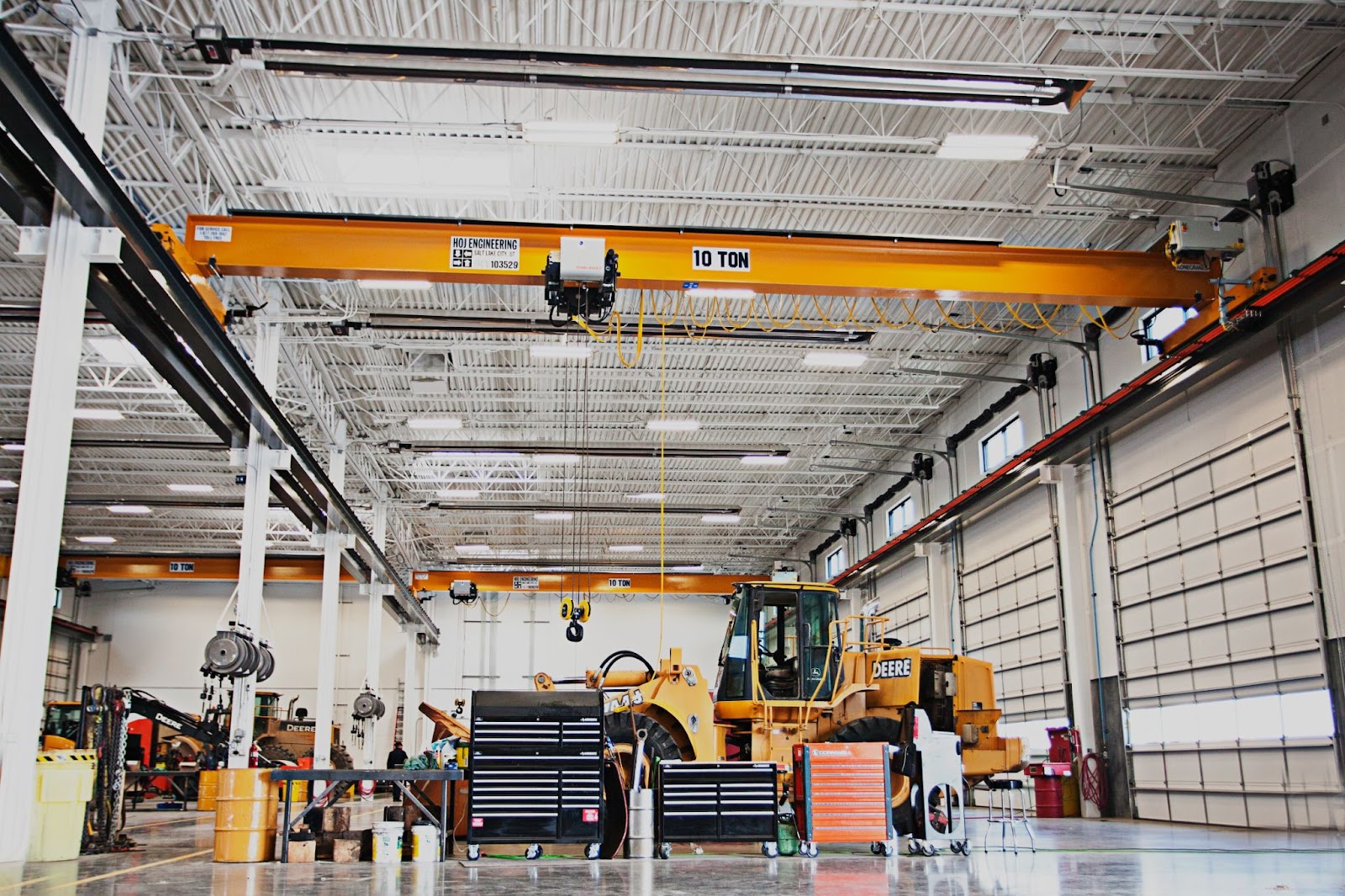
When most people picture an overhead crane, they think of a bridge crane. A bridge crane consists of a bridge beam (or beams) that spans between two runways and travels along those runways to position loads.
The runways are typically fixed to the building's columns or ceiling structure (or freestanding support columns), forming two parallel tracks. The bridge carries the hoist and trolley, allowing them to move across the width of the building, while the runways allow movement down the length of the building.
Bridge cranes are extremely common in industrial environments. Among overhead crane types, they generally offer the highest lifting capacities (They are engineered to lift hundreds of tons if needed, but here at HOJ Innovations, we limit them to a maximum capacity of 100 tons.)
Single Girder Crane
Double Girder Crane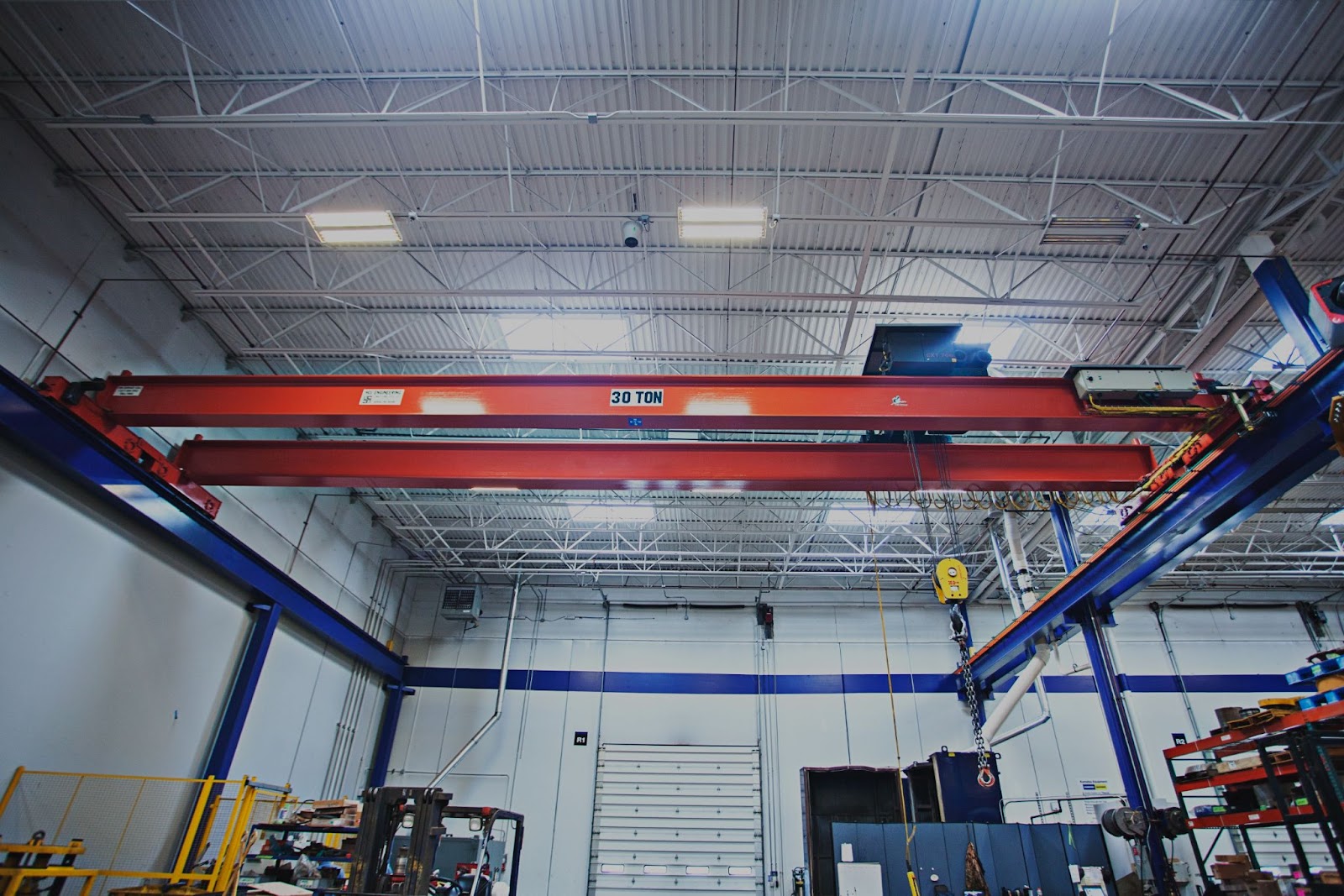
Double Girder bridge cranesuse two beams atop runway end trucks, providing extra strength for heavier loads—typically over 15 tons and up to 1 ton—across longer spans. By placing the hoist between the girders, they gain 18–36 inches of additional hook height, maximizing lift space.
Common in heavy-duty settings like steel mills and shipyards, double girder cranes also support add-ons such as maintenance platforms, cabs, and lighting. For example, TC/American's underhung double girder models share loads across two parallel track beams, allowing for shallower beam designs than equivalent single girder cranes.
Underhung Crane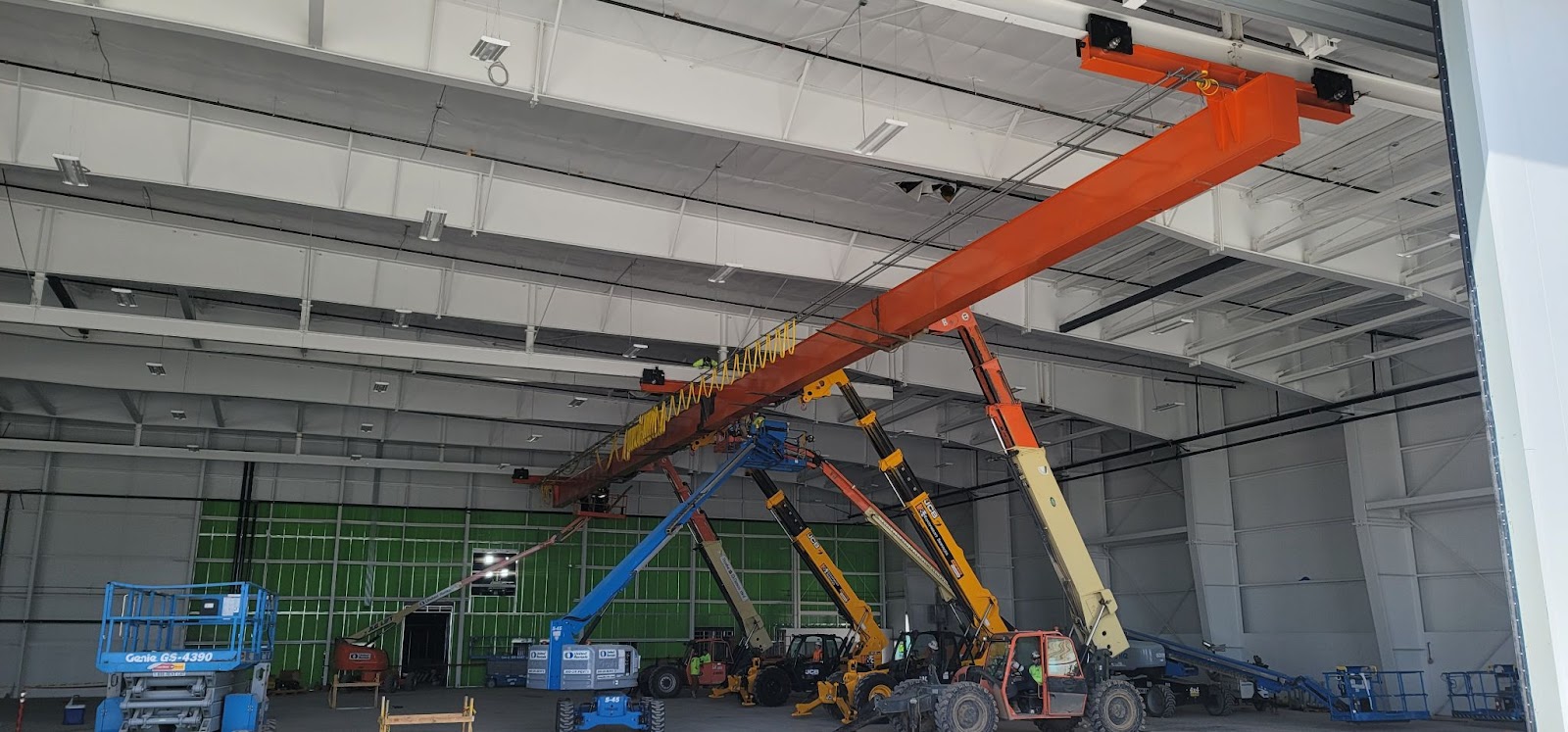
Underhung (or under-running) cranes roll along runway beams via wheels on the bottom flange, making them ideal spaces supporting low-headroom lifts.
Underhung cranes are supported by existing ceiling or roof structures and free up floor space by eliminating columns. Typically built as a single girder for lighter loads (up to 10–15 tons), they can also be designed in twin girder configurations for higher capacities.
Monorail Cranes
Monorail cranes run along a single overhead I-beam, making straight-line moves ideal for production and assembly lines—their space-saving design mounts to overhead structures, freeing floor space.
Monorails transport materials smoothly along fixed paths—straight, curved, or sloped—and deliver loads to set stations, enabling quick exchanges at each workstation without disrupting workflow. Multiple trolleys can simultaneously move loads on a single or circular track.
Overhead Gantry Crane
In the simplest Terms, "A Gantry Crane is a pre-engineered floor-supported crane that rolls." - Nate Stoute - Crane Engineer Hoj Innovations.
Overhead gantry cranes have a bridge supported on legs that run on ground rails, making them freestanding—ideal for outdoor sites like shipyards and railyards without overhead support.
They're also useful indoors, such as for occasional lifts in an auto body shop. These cranes handle light to heavy loads and can be customized by girder design, size, hoist/trolley type, power source, and mobility.
Portable Gantry Cranes
Portable gantry cranes are lightweight, wheeled lifting systems with capacities from 0.5 to 5 tons. They are ideal for temporary use in workshops, garages, and small warehouses. Their modular design allows quick assembly, easy relocation, and storage, making them a cost-effective alternative for infrequent tasks like rigging, installation, repair, and loading.
Heavy-Duty Gantry Cranes
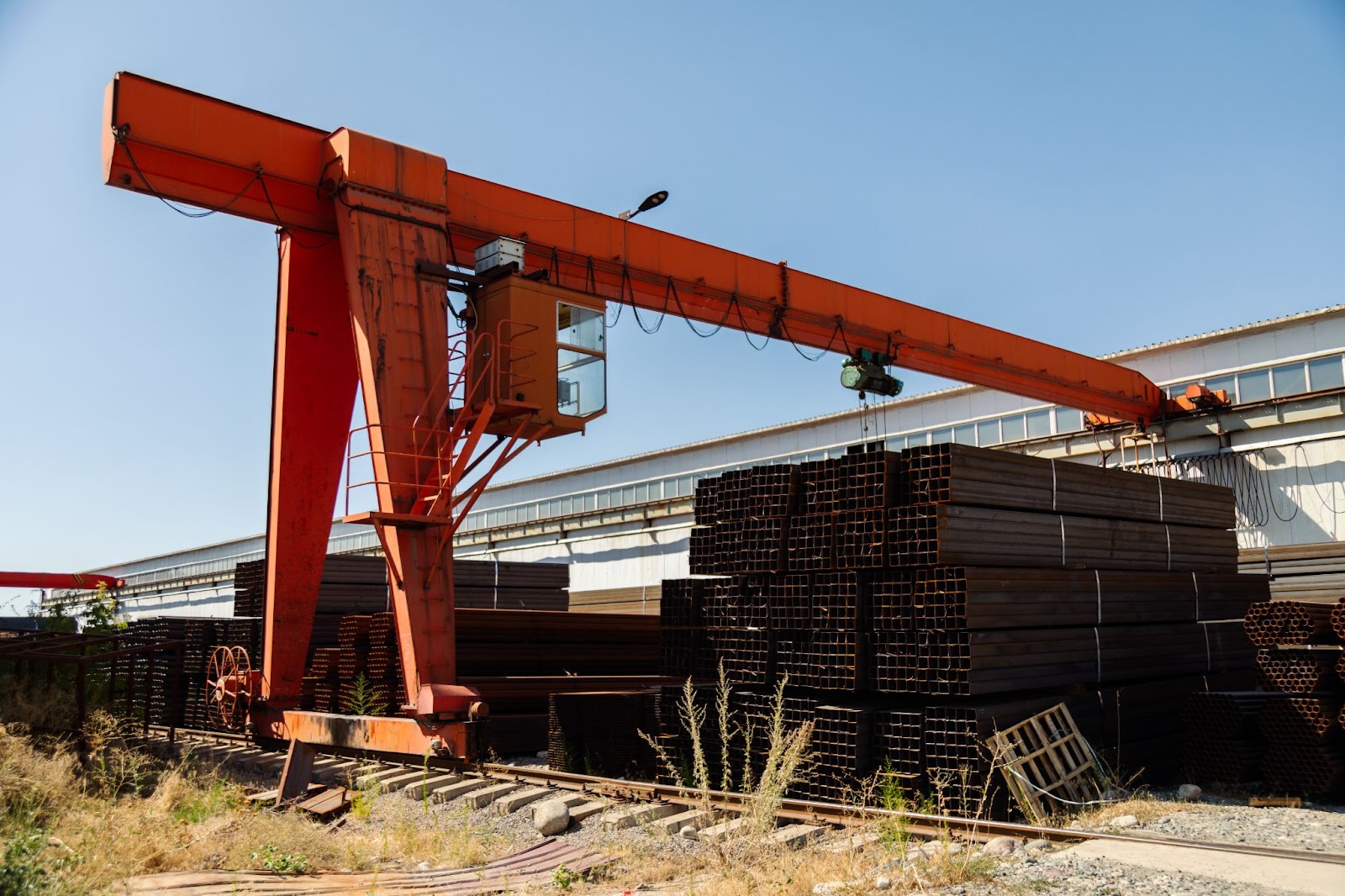
Heavy-duty gantry cranes—available as full or semi-gantry—serve heavy fabrication and outdoor yards (railroads, shipping, steel, scrap). Full gantry cranes have a cross beam and two legs on tracks with a motorized trolley hoist, lifting 5 to several hundred tons of items like steel beams, containers, or concrete sections.
Semi-gantry cranes use one leg and a wall-mounted runway, blending bridge and gantry features to save floor space and boost workflow; they can also run alongside existing overhead cranes. These cranes are common in shipyards for moving massive loads and in construction for handling concrete blocks, steel girders, and heavy lumber.
Workstation Cranes
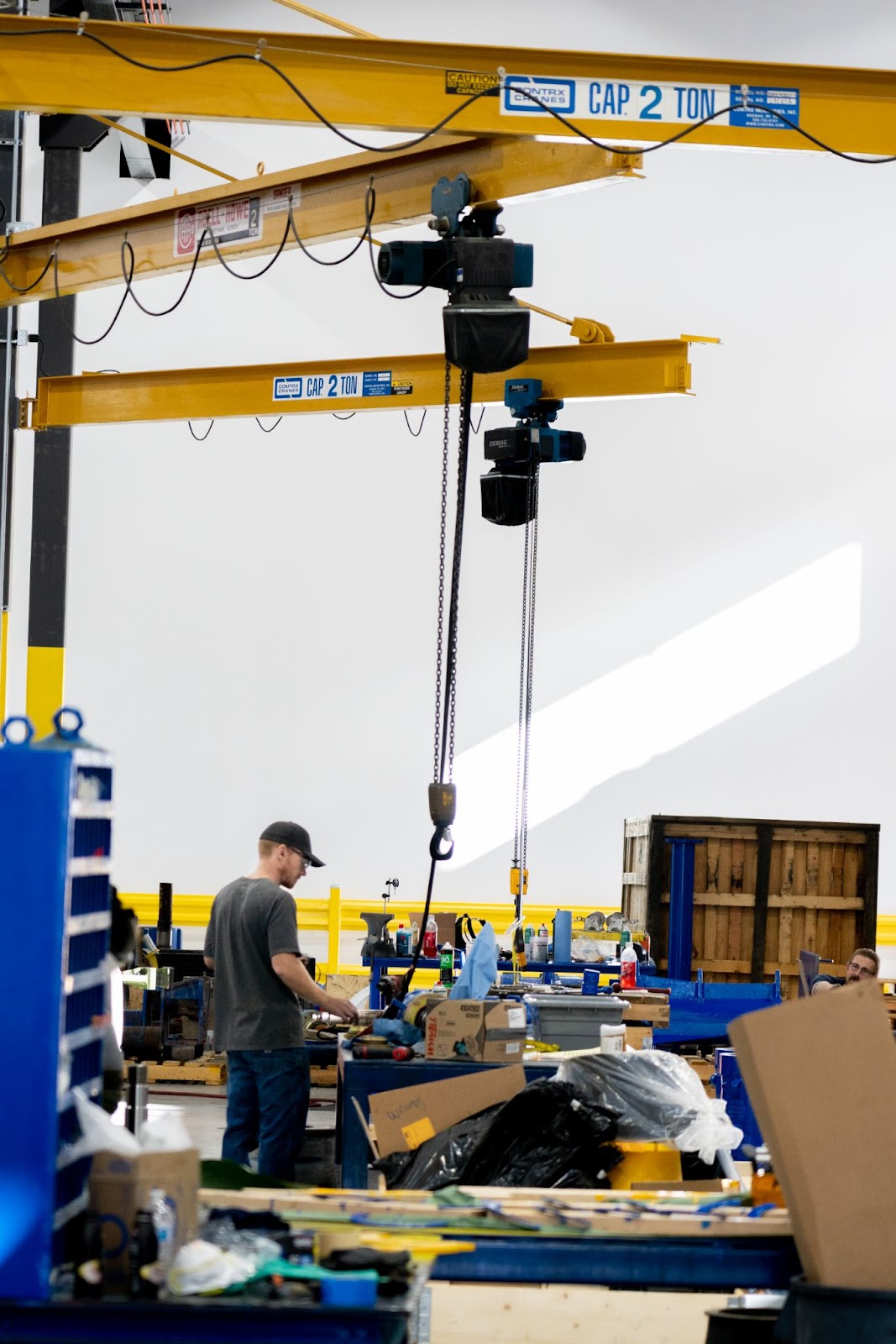
Workstation cranes (or Work-Area Cranes) handle localized lifting tasks in manufacturing, assembly, and material handling. Designed for lighter, repetitive loads, they improve efficiency by speeding up handling, reducing manual lifting risks, and enhancing ergonomics.
Available in freestanding or overhead configurations, workstation cranes require minimal structural changes and offer precise positioning. Common in manufacturing, warehousing, aerospace, automotive, food processing, and pharmaceuticals, they streamline workflows and protect workers from strain.
Jib Cranes
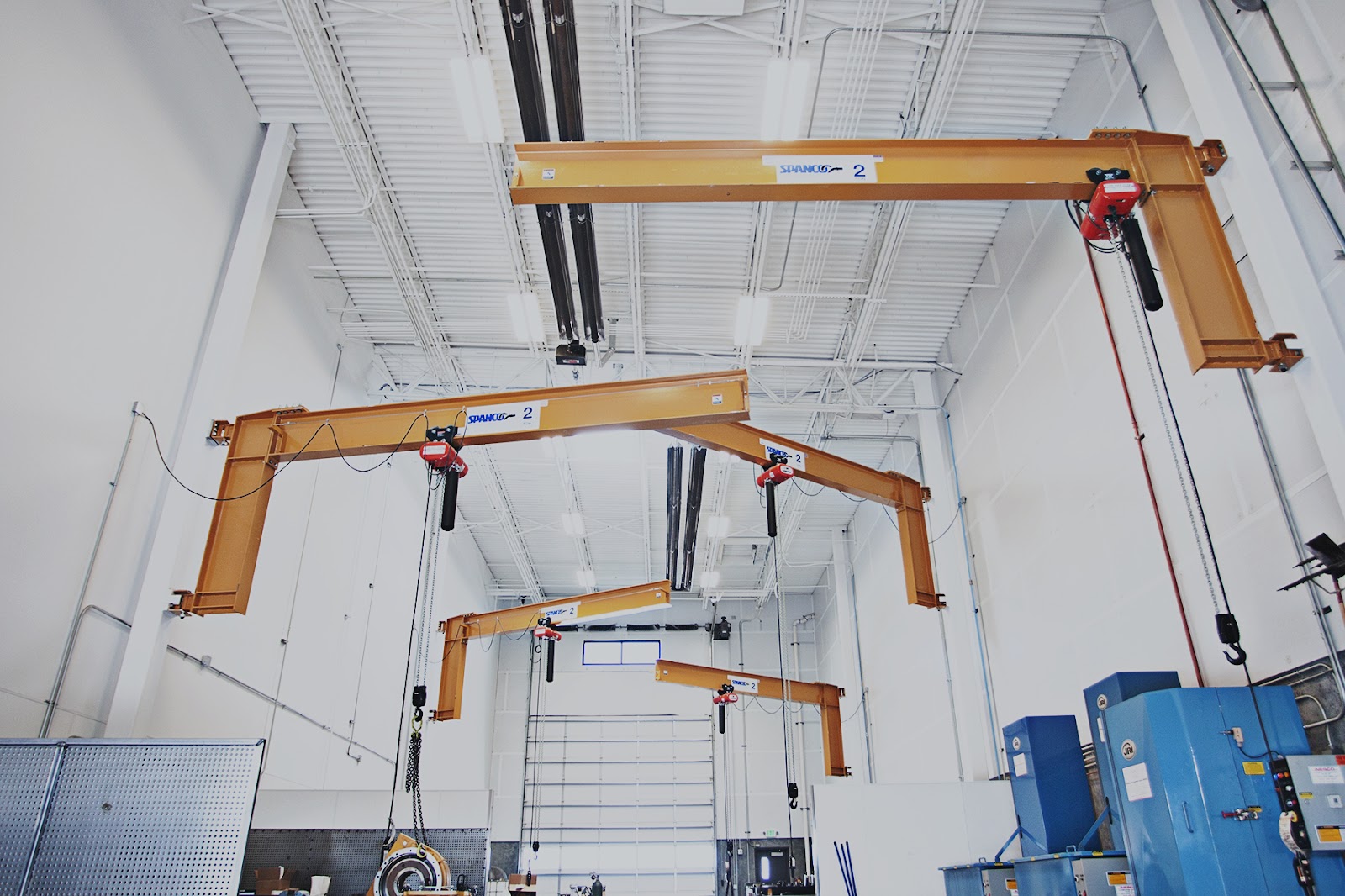
Jib cranes lift, move, and position loads within a workspace. Their rotating arm is mounted to a wall, pillar, or floor column. Ideal where overhead support is limited, jib cranes offer precise handling in manufacturing, warehouses, automotive shops, and construction sites.
Though less mobile than bridge cranes, jib cranes are cost-effective, complement other lifting systems, and save floor space.
Wall Mounted Jib Crane
Wall-mounted jib cranes attach to a structural wall or reinforced column, offering up to 180° rotation without using floor space.
They maximize workspace, require minimal installation and maintenance, and excel at frequent, repetitive lifts within a limited range. They are ideal for assembly lines, loading bays, and workshops handling lighter loads (under 1 ton).
Floor Mounted Jib Crane
Floor-mounted jib cranes (or mast/pillar-mounted) bolt to the floor or concrete foundation, offering maximum stability and 360° rotation for heavier lifts. Their robust design suits warehouses, fabrication areas, maintenance shops, and outdoor spaces without wall support.
Hook Coverage Area - Pickup Area
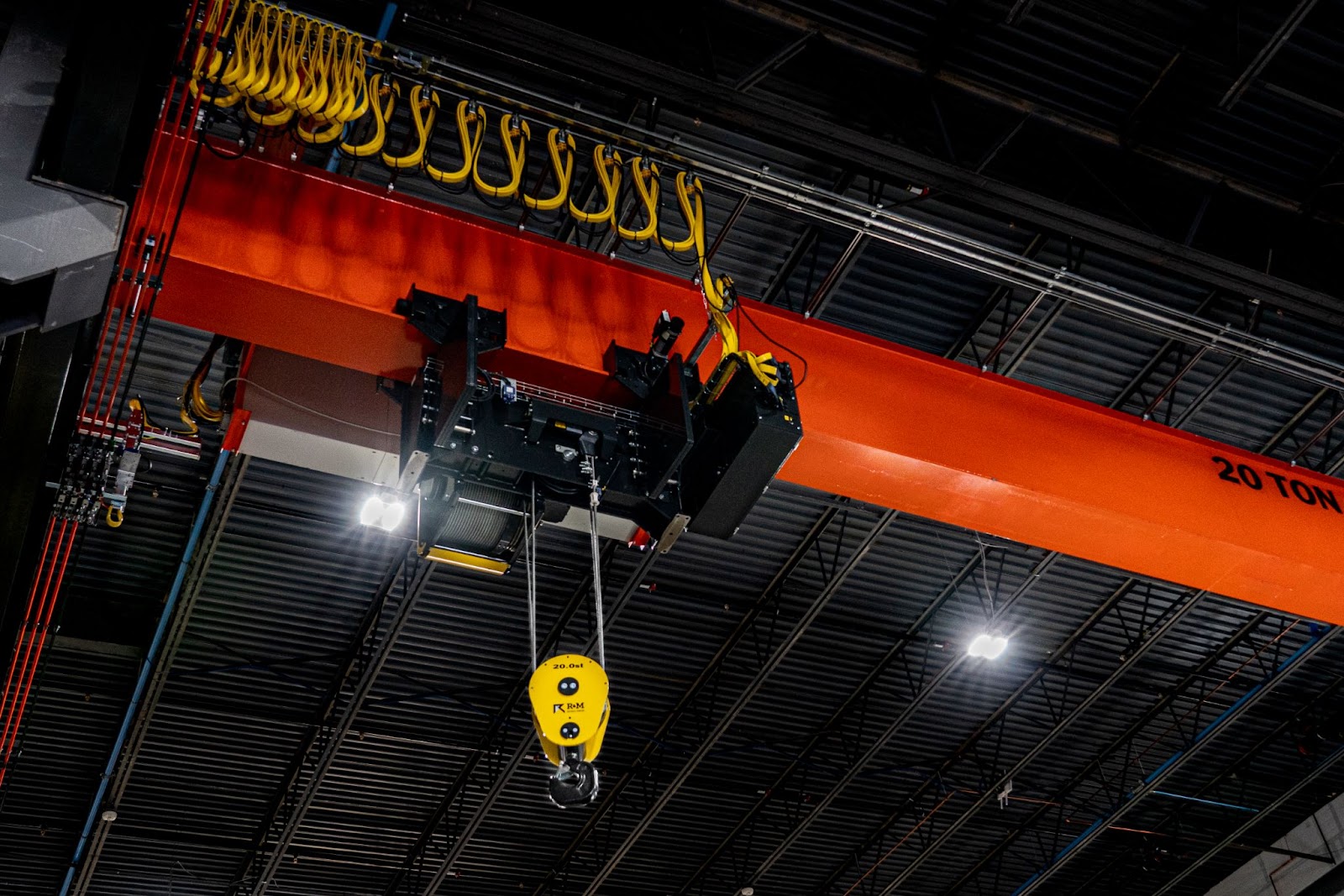
The hook coverage area defines the total floor space that an overhead crane's hook can reach within its operating bay. It consists of two primary dimensions: the span (the width between runway rails) and the runway length (the distance between the end stops along the building). Together, these determine the hook's horizontal travel envelope.
-
Span Coverage: The crane's trolley moves across the bridge girder, allowing the hook to traverse the entire bay width. To ensure full coverage, the trolley must be capable of traveling from one end-stop to the other, minus any safety clearances required to prevent collisions with columns or building restraints. In practice, the hook can access nearly 100% of the bay width, allowing operators to place or retrieve loads anywhere beneath the crane path.
-
Runway (Length) Coverage: Along the runway, the bridge girder travels the full length of the building's runway beams. The hook can reach any point along this length, leaving small approach distances at each end to avoid impact with stops or structures. This full longitudinal coverage is critical for loading or unloading materials from racks, conveyors, or workstations throughout the facility.
Together, span and runway coverage create a rectangular work envelope on the floor: the hook can be positioned at any intersection of these two travel axes. Understanding this coverage area for warehouse managers and operators ensures that material layouts, racking systems, and production lines fall within the crane's reach—maximizing productivity and minimizing blind spots.
Overhead Crane Service (Utah and Idaho)
Optimizing overhead crane systems' performance, safety, and longevity is vital for industrial operations. HOJ Innovations provides comprehensive crane services in Utah and Idaho, helping businesses maximize the reliability and lifespan of their lifting equipment.
Maintaining your crane system effectively requires a multi-faceted approach. This includes proactive care, timely fixes, knowing when to upgrade, and using the right components. Below, we'll delve into these crucial aspects: maintenance, repairs, replacement cranes, and parts.
Maintenance & Inspections
Regular inspection and maintenance are essential for crane durability, reliability, and safety. Proactive upkeep prevents small issues from turning into major problems, extends the life of the equipment, and improves workplace efficiency by reducing unplanned downtime and overall costs. A strong preventive maintenance program also increases safety for operators and ensures consistent performance.
Overhead cranes should be inspected and maintained at least quarterly, but for systems in daily use, a monthly inspection schedule is best practice. OSHA mandates preventive maintenance based on manufacturer recommendations, which typically involve checks of electrical systems such as wires, connections, and controls, along with mechanical components like gears, ropes, and brakes for wear and lubrication. Daily operator inspections of hooks, wire ropes, limit switches, and brakes are also vital to safe and reliable crane operation.
Like conveyors and other automation systems, overhead cranes perform best when designed for specific work environments and inventory management tasks. If you need to move large or heavy items safely around your warehouse, cranes provide a dependable and efficient solution. In new buildings, it can be beneficial to design the warehouse layout around the crane and its functions to maximize efficiency and long-term usability.
Working with warehouse engineers helps ensure you select the right crane for your operation and establish a proper inspection and maintenance routine. When paired with quality manufacturing and consistent care, an overhead crane will deliver reliable performance and a long service life.
Repairs
Even with diligent maintenance, cranes require repairs. Common issues include damaged wire rope, crane skew, end truck wheel wear, and electrical problems (e.g., contact interruptions, worn brushes, and blown fuses). Bent or damaged hooks also compromise integrity.
Indicators for repair include loud scraping sounds, broken wheel flanges, abnormal wear, increased power demand, or wheel climbing rails. Unresponsive controls or frequently blowing fuses signal electrical issues. Prompt repair prevents further damage, costly downtime, and safety hazards.
Signs You Need To Replace Your Crane
A crane must be replaced when it no longer meets operational demands, experiences frequent failures, or poses safety risks due to outdated technology. Key indicators include changes in lifting capacity or duty cycle, excessive wear and maintenance, scarcity of spare parts, and lack of modern safety features.
Upgrading or modernizing existing cranes can extend their useful life, improve safety and efficiency, and often cost less than purchasing entirely new equipment.
What You Need To Know About Crane Parts
Because cranes work under heavy loads, high-quality OEM parts are crucial for fit, warranty, and durability. They last longer, lower long-term costs, and include items like hooks, wheels, bearings, controls, electrical components, brakes, and motors. Regular inspection and timely replacement keep crane operations safe and efficient.
Crane Hoists
The hoist is the critical component of an overhead crane and is directly responsible for lifting and lowering loads. By enabling vertical movement, hoists allow materials to be transported overhead without obstructing floor-level activities. This capability is essential for handling heavy items and reducing the ergonomic risks associated with repetitive manual lifting.
Hoists are classified by their lifting medium—wire rope or chain—and their power source—manual, electric, or air. Their lifting capacity depends on construction, and they are operated manually, via a pendant control, or with a wireless remote. Because hoists are supplied separately from the crane structure, they can be easily swapped or customized with different below-the-hook attachments.
Wire Rope Hoists
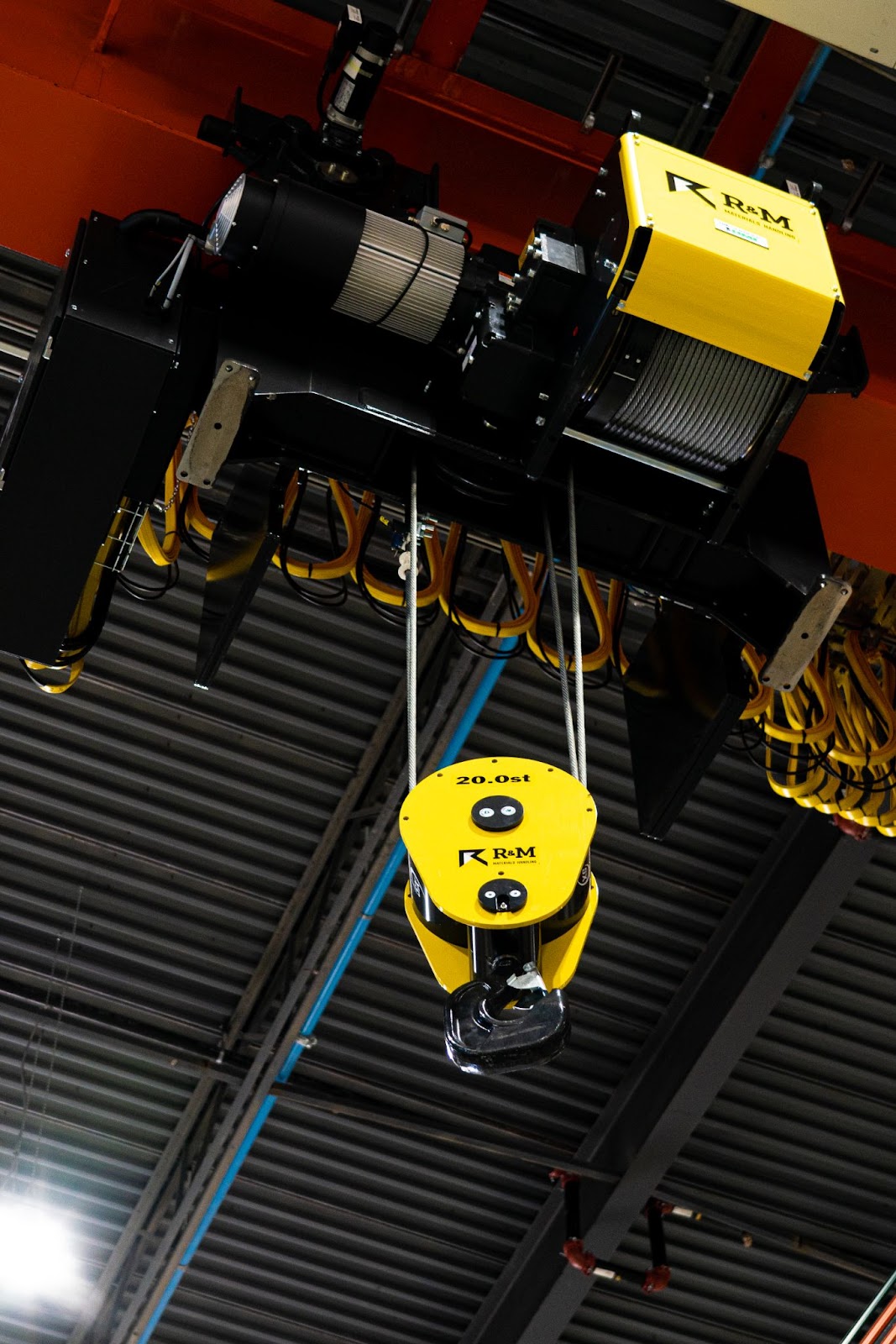
Electric wire rope hoists are favored in heavy-duty industries—manufacturing, mining, construction, and logistics—and are commonly used in various warehouses for their strength and reliability. They handle loads from a few hundred kilograms to 80–100 tons, offering fast, smooth operation via variable-speed electric motors and advanced controls.
Durable and comparatively quiet, they feature compact, energy-efficient designs with safety devices like overload limiters and limit switches to ensure long service life and compliance with industry requirements.
Electric Chain Hoists
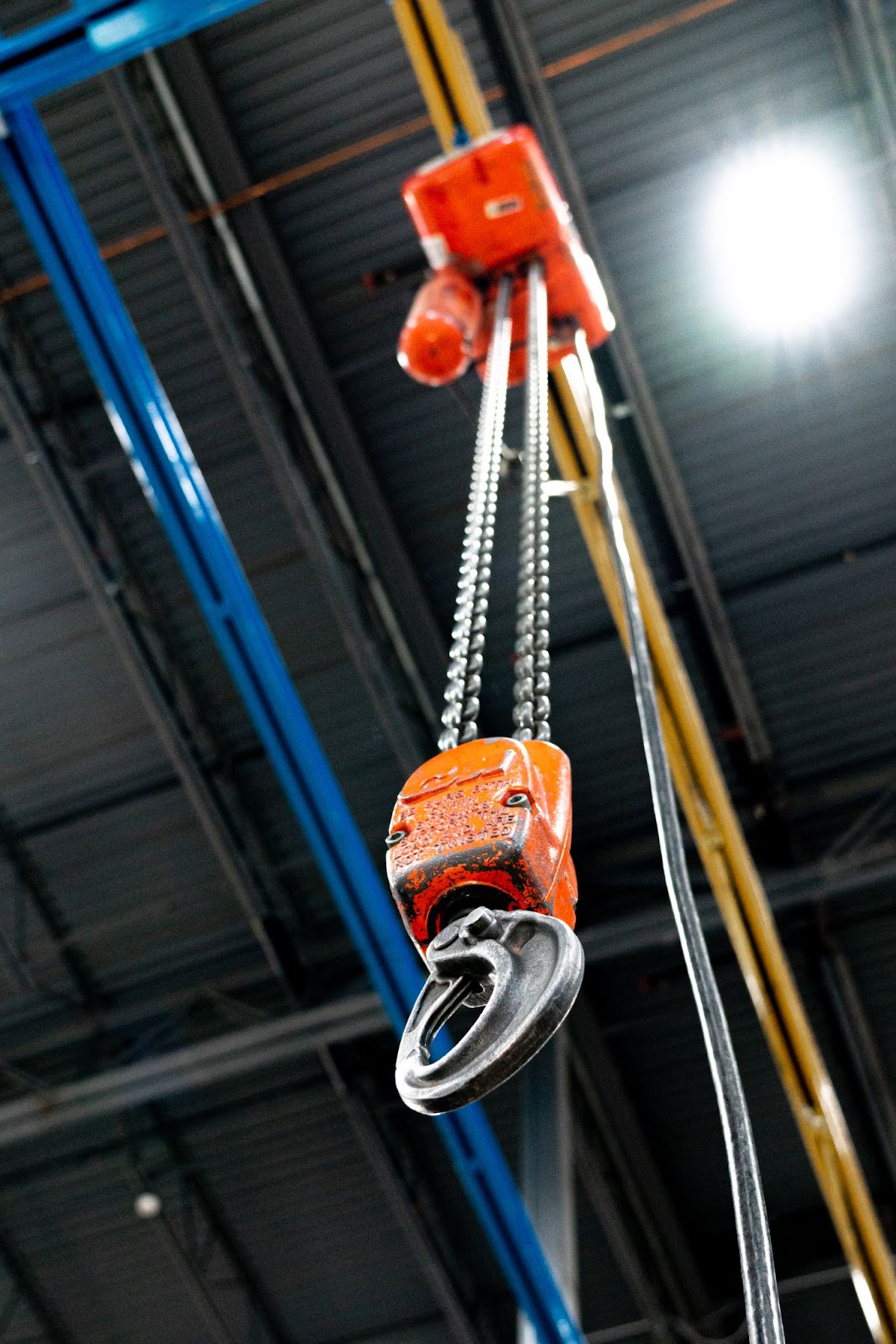
Electric chain hoists simplify lifting tasks in sectors such as oil and gas, engineering, and cement. They are also widely used across warehouses, automating loads from several hundred pounds up to 30 tons.
They enhance productivity and ergonomics with quiet, precise operation and optional overload protection. Cost-effective and easy to service, they conform to standard dimensions, perform reliably in harsh or high-temperature environments, and offer multiple speed options and variable control for accurate positioning.
General Codes & Regulations
Compliance with safety standards and regulations is not merely a legal obligation but a critical foundation for safe and efficient overhead crane operations.
Importance of Compliance with Safety Standards
Following safety standards reduces accidents and protects both personnel and equipment. This leads to smoother operations with less downtime, which boosts overall efficiency and productivity. Proper crane classification and use prevent overuse and excessive wear, extending equipment lifespan and maintaining optimal performance. A strong safety record also enhances reputation and fosters better client relationships.
Risks Associated with Non-Compliance
Failing to follow safety regulations endangers workers and can result in hefty fines, legal liability, and reputational damage. Common hazards include dropped loads, collisions, electrical shocks, mechanical failures from poor maintenance, and operator errors. Even built-in safety factors can't prevent accidents if a crane is overloaded. Over the course of ten years, OSHA data showed that 70% of the 270 injuries and fatalities could have been avoided if the regulations and safety guidelines had been followed.
Where Can I Find Codes and Regulations for My Area?
Most crane regulations originate at the federal level (e.g., OSHA's 1910.179 for overhead bridge and gantry cranes), but many jurisdictions add state- or local-specific requirements.
In practice, you'll want to check with your local building department—where construction codes often dictate crane specifications, permits, and inspection rules—and with your state labor or OSHA office for operator certification, inspection schedules, and safety practices.
Always confirm whether you need city-issued crane permits, clearances for power-line work, or special certifications beyond OSHA's baseline.
HOJ fabricates and installs overhead bridge and gantry cranes according to CMAA Specifications 70 and 74, which are industry-standard guidelines set by the Crane Manufacturers Association of America (an affiliate of MHI). Following CMAA's design and installation criteria, our cranes meet rigorous performance, quality, and safety requirements.
Ensuring Long-Term Success with Overhead Cranes
Overhead cranes have long been essential for lifting heavy loads safely and efficiently, and modern systems continue to evolve with advanced technology and safety features.
Their modular designs improve space use, workflow, and adaptability to changing production needs, translating into cost savings, reduced labor dependency, and higher uptime. For warehouse managers, business owners, and construction buyers, choosing the right crane involves balancing performance, safety, and long-term value.
According to Nate Stout, Hoj's in-house Crane Engineer, People Choose Hoj Innovations because "We answer the phone, and we respond, and we are there. If there is ever a problem, we fix it. We'll be there the entire way, and we will not leave them hanging."
Working with an experienced partner like HOJ Innovations can help you navigate equipment selection, installation, maintenance, and compliance, ensuring your crane delivers reliable service throughout its lifespan.
READY TO GET STARTED?
REACH OUT TO US TODAY
Whether it’s a project, product, repair or service, let’s chat to see if we can make your warehouse operations more efficient.
READY TO GET STARTED?
REACH OUT TO US TODAY
Whether it’s a project, product, repair or service, let’s chat to see if we can make your warehouse operations more efficient.