
Your Cart is Empty






Overhead Crane Motor Overheating Prevention

Unplanned manufacturing downtime now averages roughly $260,000 per hour across all sectors and crests above $2.3 million per hour in automotive plants, perAberdeen downtime data. A single afternoon of crane thermal trips in July can wipe out a quarter's maintenance budget.
Most overhead crane motor overheating events are preventable when teams understand four variables: motor insulation class, duty cycle, how the thermal protection device senses heat, and ambient derating. This guide consolidatesNEMA MG 1 limits, theCMAA 70-2025 update, and OSHA and ASME inspection requirements into a pre-summer readiness program.
Table of Contents
-
Why Overhead Crane Motors Overheat
-
NEMA Classes and Ambient Derating
-
Duty Cycle and CMAA Class
-
Klixon vs Overload vs VFD
-
What OSHA and ASME Require
-
Pre-Summer Thermal Checklist
-
Retrofit Decision Matrix
-
Build a Heat-Resilient Program
Why Overhead Crane Motors Overheat
Every NEMA-rated motor is designed around a 40°C ambient reference. When a non-conditioned mill climbs into the high 30s or low 40s, runway-elevation temperatures run higher because hot air rises and stratifies near the roof structure where the crane operates.
Three-shift continuous operation compounds the problem by pushing existing CMAA Class C cranes into Class D or E duty profiles, particularly when production schedules expand without a corresponding crane rerate.
Mechanical drag adds the third layer: a brake that fails to fully release, a skewed bridge, or a tight trolley wheel forces the motor to overcome extra torque, raising winding current and turning a marginal thermal condition into a shutdown.
NEMA Classes and Ambient Derating
NEMA MG 1 defines four insulation classes commonly seen on crane motors. Each class has a published total-temperature limit: the sum of the 40°C ambient, the allowable winding rise, and a small hot-spot allowance.
|
Insulation Class |
Total Temperature Limit |
Allowable Winding Rise |
|
Class A |
105°C |
60°C |
|
Class B |
130°C |
80°C |
|
Class F |
155°C |
105°C |
|
Class H |
180°C |
125°C |
Operating a Class F motor at its 155°C ceiling yields roughly 20,000 hours of design life. Run the same Class H motor at 155°C instead of its 180°C ceiling and life expectancy stretches to about 120,000 hours, a six-fold improvement perClass F life.
TheArrhenius 10°C rule explains the leverage: for every 10°C above the rating, insulation life is cut by approximately half; for every 10°C below, life roughly doubles. A commonambient derating rule is 1 percent loss in rated output per degree above 40°C, so a runway hitting 50°C costs roughly 10 percent of nameplate horsepower before any duty-cycle math. For non-conditioned bays, specify Class H insulation.
Duty Cycle and CMAA Class
Crane motors care more about motor starts per hour than lifts per hour, because inrush current dumps a brief but intense pulse of I²R heat into the windings on every start.CMAA service classes organize this into six tiers, from Class A (standby) through Class F (continuous severe).
|
CMAA Service Class |
Typical Lifts/hr |
Motor Starts/hr |
|
A (Standby/Infrequent) |
up to 2 |
75 |
|
B (Light) |
2 to 5 |
75 |
|
C (Moderate) |
5 to 10 |
150 |
|
D (Heavy) |
10 to 20 |
300 |
|
E (Severe) |
20+ |
600 |
|
F (Continuous Severe) |
rated-capacity continuous |
varies |
HMI and ASME hoist motor time ratings tie directly to these classes. Standard hoist motors are sold as 15-minute (H3), 30-minute (H4), or 60-minute (H5) duty designs per theHMI duty ratings.
A 15-minute hoist motor installed on a true Class D duty cycle is the canonical thermal-failure profile: the motor never gets enough off-time to dump accumulated winding heat before the next lift begins. The 2025 CMAA 70 update adds a NEMA-to-IEC motor appendix that procurement teams should cite when sourcing replacements globally.
Klixon vs Overload vs VFD
Three protection strategies cover most overhead cranes. Each senses heat differently.
A thermal overload relay is panel-mounted and monitors current on all three motor leads. It protects against sustained overloads and locked-rotor heat but models current, not winding temperature. It cannot see fast winding spikes during high-frequency starts, blocked ventilation, or externally heated motors.
A klixon, the common name for anembedded motor thermostat, is a snap-acting bimetallic disc buried in the winding. When winding temperature reaches the trip point (typically 75°C to 150°C), the disc opens the control circuit. It senses actual winding temperature and responds to every heat-creating condition: overcurrent, blocked airflow, high ambient, brake drag. It is too slow to protect against a locked-rotor stall, so the consensus is to run klixons alongside conventional overload relays, not instead of them.
A VFD-based thermal model with PTC or PT100 input is the modern best practice for new cranes and serious retrofits. Crane-rated drives from major drive OEMs compute an electronic thermal model from current, frequency, time-on, time-off, and the motor cooling curve, and they log thermal events for trending. Reduced-voltage soft-starters are not appropriate for high-duty crane service; they generate substantial waste heat themselves and overheat motors during frequent starts.
What OSHA and ASME Require
OSHA 1910.179 brakes governs overhead and gantry cranes. Section 1910.179(f)(2) requires hoist holding brakes to have "ample thermal capacity for the frequency of operation required by the service." The parallel clause for trolleys and bridges sits in 1910.179(f)(4). Brake heat soaks into the motor through the shaft and housing, so this language indirectly mandates motor thermal awareness. Section 1910.179(j) establishes the frequent and periodic inspection regime for motors, brakes, controls, and electrical equipment.
ASME B30.2 inspection organizes crane inspections into pre-shift, frequent, and periodic tiers. Periodic inspection explicitly covers brake adjustment and lining condition, contactor wear and conductor condition, and motor mounting, performance, and abnormal heat indications. A pre-summer thermal walk-down is the natural place to roll several B30.2 periodic items into a single focused session.
Pre-Summer Thermal Checklist
Run this as a one-day walk-down before the first week of sustained 90-degree weather.
-
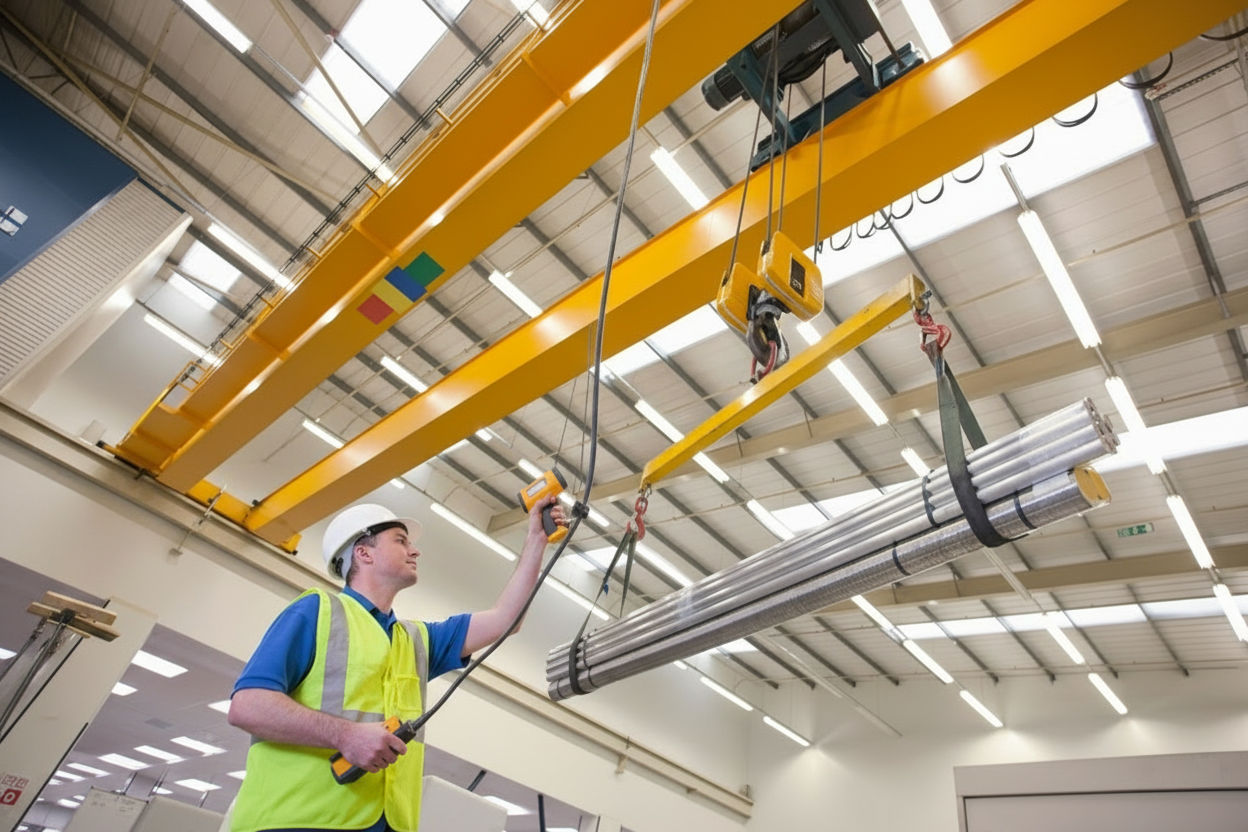
Take handheld IR readings on hoist, bridge, and trolley motors at full operating temperature. A 10°C rise over baseline cuts insulation life in half.
-
Log ambient at crane elevation. Runway-level ambient may run 5 to 10°C above floor ambient.
-
Inspect main contactors for pitting, weld marks, and discoloration. Damaged contactors run hot and cascade into motor protection events.
-
Verify brake clearance and coil resistance against spec. A dragging brake forces the motor to run against torque it was not designed to overcome.
-
Inspect collector shoes, conductor bar alignment, and festoon cable insulation.
-
Confirm control cabinet filters, fans, and AC are clear. VFD waste heat derates or trips the drive when cabinet cooling fails.
-
Check wheel and trolley alignment. Heat at the wheel signals skew, brake drag, or rail clearance issues.
-
Confirm overload relay settings match motor FLA, and that klixon or PTC circuits are wired through the contactor seal-in.
Retrofit Decision Matrix
When inspection turns up a recurring thermal problem, three retrofit paths dominate. Cost bands are budgetary; site conditions will move them.
|
Upgrade |
Installed Cost Band |
When It Fits |
|
Klixon retrofit on existing motor |
$400 to $1,200 per motor |
Older motor without embedded thermal sensing |
|
Motor replacement, Class B to Class H, equivalent frame |
$3,500 to $12,000 per motor |
Repeat thermal trips; ambient consistently above 40°C |
|
VFD with built-in thermal model and PTC input |
$4,000 to $15,000 per drive |
High-duty service; data logging required |
Payback math is driven by avoided downtime and avoided motor damage. Aberdeen pegs manufacturing downtime at roughly $260,000 per hour on average and over $2.3 million per hour in automotive plants. Against numbers like those, a $400 klixon retrofit pays for itself the first time it catches a heat-related condition that an overload relay would have missed, typically before a winding burns or a drive cascades.
Build a Heat-Resilient Program
Heat-resilient maintenance is the convergence of four disciplines: matching motor insulation class to actual operating temperature, sizing thermal protection to how crane motors heat in service, managing duty cycle against the CMAA service class the crane was specified for, and running an inspection cadence anchored to ASME B30.2 periodic requirements.
If your runway routinely exceeds 40°C ambient or production has stepped up, a complimentary HOJ 3D Strategic Planning consultation folds thermal readiness into a broader review of how space, racking, and overhead handling work together.