
Your Cart is Empty





Overhead Crane Gearbox Maintenance: Oil Analysis, Lubrication, and Failure Modes

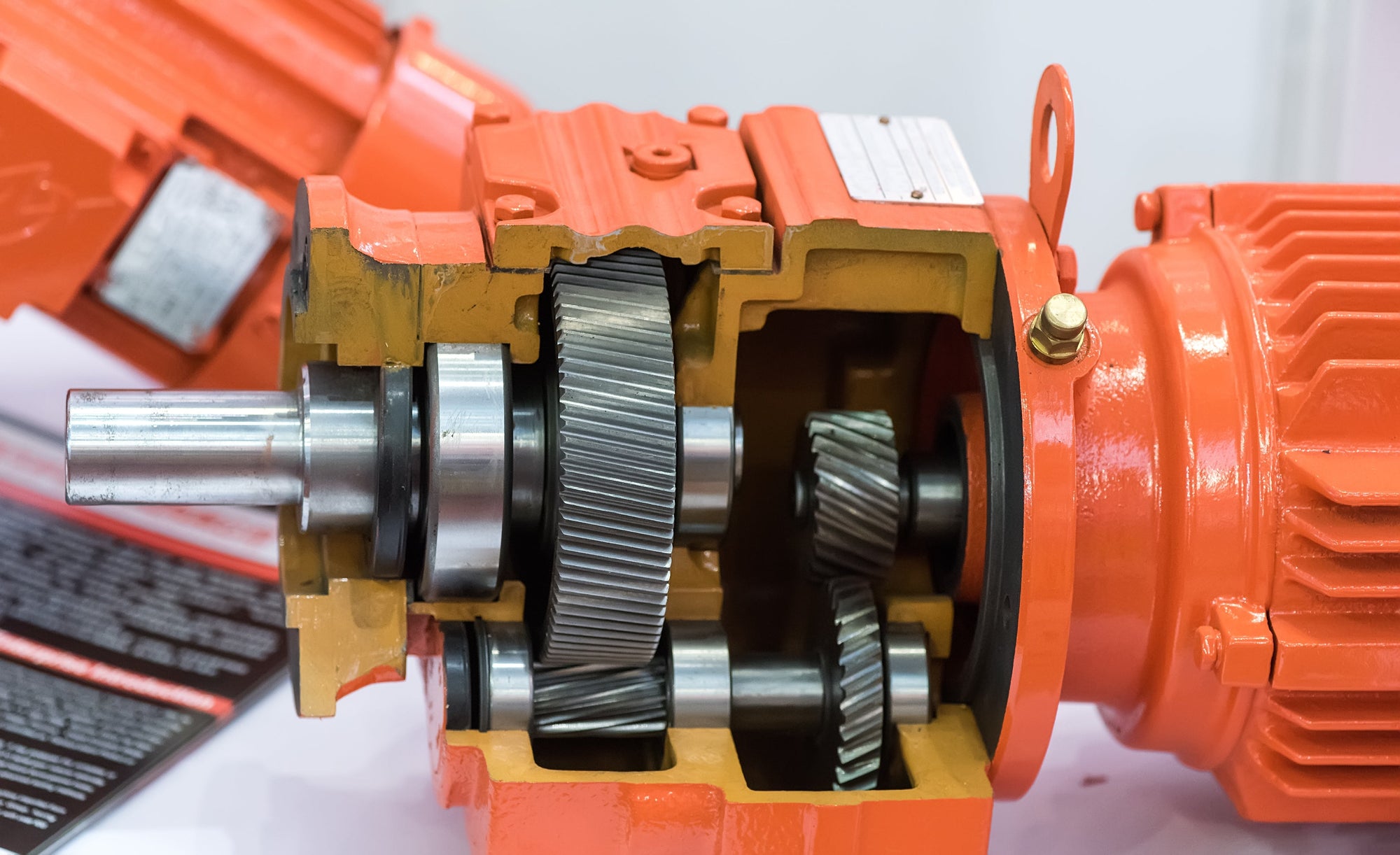
An unplanned bridge or hoist gearbox failure takes a production line out for days, not hours, while industrial oil analysis runs $30 to $50 per sample at independent labs.
A quarterly program on twenty crane gearboxes fits a four-figure budget against six-figure-per-hour production losses.
Four decisions drive overhead crane gearbox life: lubricant selection, oil analysis, service factor sizing, and chemistry-driven change intervals, all governed by OSHA 1910.179, ASME B30.2-2022, CMAA 70-2025, ANSI/AGMA 1010-F14, and ANSI/AGMA 9005-F16.
Table of Contents
-
Standards and Inspection Scope
-
CMAA Service Factor Creep
-
AGMA Lubricant Selection
-
Oil Analysis Six-Test Panel
-
Failure Modes and Intervals
-
Root-Cause Failure Forensics
-
Building the Program
Standards and Inspection Scope
OSHA 29 CFR 1910.179 requires frequent and periodic inspections of overhead and gantry cranes, with periodic inspections at 1 to 12 month intervals covering worn, cracked, or distorted gears, shafts, and pins.
The regulation leaves oil-change intervals to OEM and AGMA practice. TheASME B30.2-2022 standard covers construction, installation, operation, inspection, and maintenance of overhead and gantry cranes. TheCMAA 70-2025 updates tightened key and keyway stress definitions, revised hoist light-load overspeed protection, and expanded fatigue stress guidance.
CMAA Service Factor Creep
Every gearbox is sized against a service factor that multiplies calculated input torque for shock, duty cycle, and operating hours. TheSumitomo service-factor whitepaper places approximately 1.4 on heavy-shock intermittent operation, mapping to CMAA Class C to D. TheCMAA crane classifications:
|
CMAA Class |
Typical Application |
Service Factor |
|
A |
Standby / utility |
1.0 |
|
B |
Repair shops, light warehousing |
1.0 to 1.12 |
|
C |
Machine shops, moderate duty |
1.25 to 1.4 |
|
D |
Heavy machine shops, foundries |
1.4 to 1.6 |
|
E |
Magnet / bucket cranes, cement mills |
1.6 to 2.0 |
|
F |
Continuous severe production |
2.0+ |
Duty cycle creep is the silent killer. Cranes commissioned at Class C frequently migrate to Class D as production speeds up, and gearboxes sized for Class C that now operate at Class D run hotter and wear faster. Recheck CMAA service class against actual lifts per hour every 24 to 36 months, and recalculate the service factor whenever line throughput or product mix changes.
AGMA Lubricant Selection
TheANSI/AGMA 9005-F16 standard sets viscosity grade selection for industrial gear drives, mapping AGMA grades to ISO 3448. AGMA 5 matches ISO VG 220 (220 cSt at 40 C); AGMA 6 matches ISO VG 320. Bridge and trolley drives typically run AGMA 5; low-rpm high-torque hoist gearboxes run AGMA 6 for boundary lubrication.
Mineral gear oils remain acceptable below 71 C (160 F) bulk oil temperature. Above 82 C (180 F), or when intervals extend past 4,000 hours, synthetic PAO or PAG base oils deliver better oxidation resistance and viscosity index.
Oil above 93 C (200 F) loses viscosity rapidly: a hard trigger to convert to synthetic or fix the root cause. When converting, drop one ISO grade because synthetics carry a higher viscosity index. TheSEW-Eurodrive lubricant guide places typical change intervals at 7,500 to 10,000 hours or annually, depending on conditions. The OEM manual governs.
Oil Analysis Six-Test Panel
A defensible oil-analysis program uses six ASTM-based tests:
-
Kinematic viscosity at 40 C (ASTM D445): alarm on ±10 percent deviation from baseline.
-
Total Acid Number (ASTM D664): alarm on +0.5 mg KOH/g rise or 2x new-oil value (oxidation, additive depletion).
-
Water content (Karl Fischer ASTM D6304): investigate above 200 ppm; action above 500 ppm.
-
Elemental spectrography (ASTM D5185): quantifies iron, copper, lead, tin, aluminum, chromium, silicon, and additive elements.
-
Particle count testing (ISO 4406 via ASTM D7647): target 19/17/14; action level 21/19/16.
-
FTIR: trend antiwear, antioxidant, EP, and oxidation bands.
Wear-metal alert levels follow establishedoil analysis interpretation practice. Iron above 100 ppm, or copper and aluminum above 15 ppm, flags abnormal wear; iron above 300 ppm suggests excessive gear or bearing wear; a jump of more than 15 ppm between samples signals accelerating wear regardless of absolute value. Trending beats absolute thresholds: baseline within 500 hours of a fill, then sample quarterly.
Pattern points at the failing component: iron with stable copper at gears or shafts; copper with stable iron at bronze bushings; copper, lead, and tin co-rising at babbitt bearings; iron and chromium at rolling-element bearings; a silicon spike with rising iron at abrasive ingress.
Failure Modes and Intervals
TheANSI/AGMA 1010 standard defines the gear failure terminology. Macropitting indicates thin lubricant film or excessive contact stress: raise viscosity, reduce load. Micropitting calls for synthetic base oils and MoS or W additive packages. Scuffing points to insufficient EP additives; abrasive wear to filtration; bending fatigue to an undersized gearbox or overload, calling for a service factor recalculation, not a lubricant change.
Oil-change intervals follow oil chemistry and operating temperature, not the calendar:
|
Oil Type |
Typical Interval |
Conditions |
|
First-fill / break-in |
300 to 500 hours |
After commissioning |
|
Mineral gear oil |
2,000 to 4,000 hours or 12 months |
Bulk oil below 71 C |
|
Synthetic PAO/PAG |
8,000 to 10,000 hours; 16,000 in clean service |
Higher temperatures or extended drains |
For a fleet in Class D service at 4,000 hours per year, synthetic conversion replaces two mineral changes annually with one every two years and protects the upper temperature band. Labor savings alone typically cover the synthetic premium within a year on a mid-size fleet. Cross-check intervals against the OEM manual.
Root-Cause Failure Forensics
Most moisture in a gearbox enters through the breather, per Machinery Lubrication'sdesiccant breather guide. Silica gel beads in desiccant breathers extract water vapor from incoming air, making a desiccant retrofit one of the lowest-cost reducer-life extenders available, a sub-$200 swap on a three to six month cadence per Noria.
The walkdown also covers gaskets, plug torque, magnetic-plug debris, and oil odor: milky oil means emulsified water; a burnt smell with darkening signals oxidation; fine glitter on the magnetic plug points at gear wear, coarser chunks at bearing failure.
Bridge-drive misalignment quietly damages gearboxes. When one drive in a separately driven bridge has greater gear clearance than the other, or shaft couplings loosen on one side, the wheels run at different effective speeds, causing skew and torque imbalance.
Per Columbus McKinnon'scrane skewing recommendations, common causes include loose drive shaft couplings, drive wheels not running truly parallel, and bridge drive motors producing mismatched output speeds. Early symptoms include squealing and rail polishing, escalating to hot spots and metal dust on wheel treads.
A skew treated as a wheel problem is often a gearbox problem waiting to surface.
Building the Program
A practical program runs three tiers. Critical cranes get monthly sampling, quarterly inspection ports, and semi-annual breather replacement.
Important cranes get quarterly sampling and annual breathers. Standard Class A or B cranes get semi-annual sampling and annual inspection.
Quarterly sampling on twenty gearboxes at $40 each runs $3,200 per year, paid back many times over by a single avoided unplanned failure. Three years of oil analysis, wear-metal trending, and vibration data form the business case for any rebuild-versus-replace decision.
HOJ Innovations specifies, installs, and maintains bridge, overhead, and gantry cranes as part of complete warehouse and manufacturing solutions. A complimentary 3D Strategic Planning consultation can include a CMAA service-class review and gearbox sampling plan within the broader goal of making more of your space.