
Your Cart is Empty







Jib Crane vs. Overhead Crane: How to Choose the Right Lifting Solution

A jib crane and an overhead bridge crane are not competitors. They solve different geometry problems, and buyers who frame the jib crane vs overhead crane choice as cheap versus capable usually buy the wrong machine. A jib covers a circle around one fixed point; a bridge crane covers a rectangle the size of a full bay. The right choice depends on coverage, capacity, cost, and the standards that govern each.
Coverage Geometry Decides First
The first variable is the shape of the area you cover, not the weight of the load. A jib crane uses a rotating boom that pivots around one fixed point, covering a circle or semi-circle, which limits it to one or two workstations. An overhead bridge crane travels two parallel runway beams and covers a rectangular bay corner to corner, with runways that can extend the full length of a facility.
Capacity is the second filter. Freestanding jib cranes from major manufacturers typically cap around 15 tons and reach up to 50 feet. A double-girder bridge crane has no practical limit on span or capacity. A jib has a configuration-imposed capacity cap; a bridge crane does not.
When a Jib Crane Wins
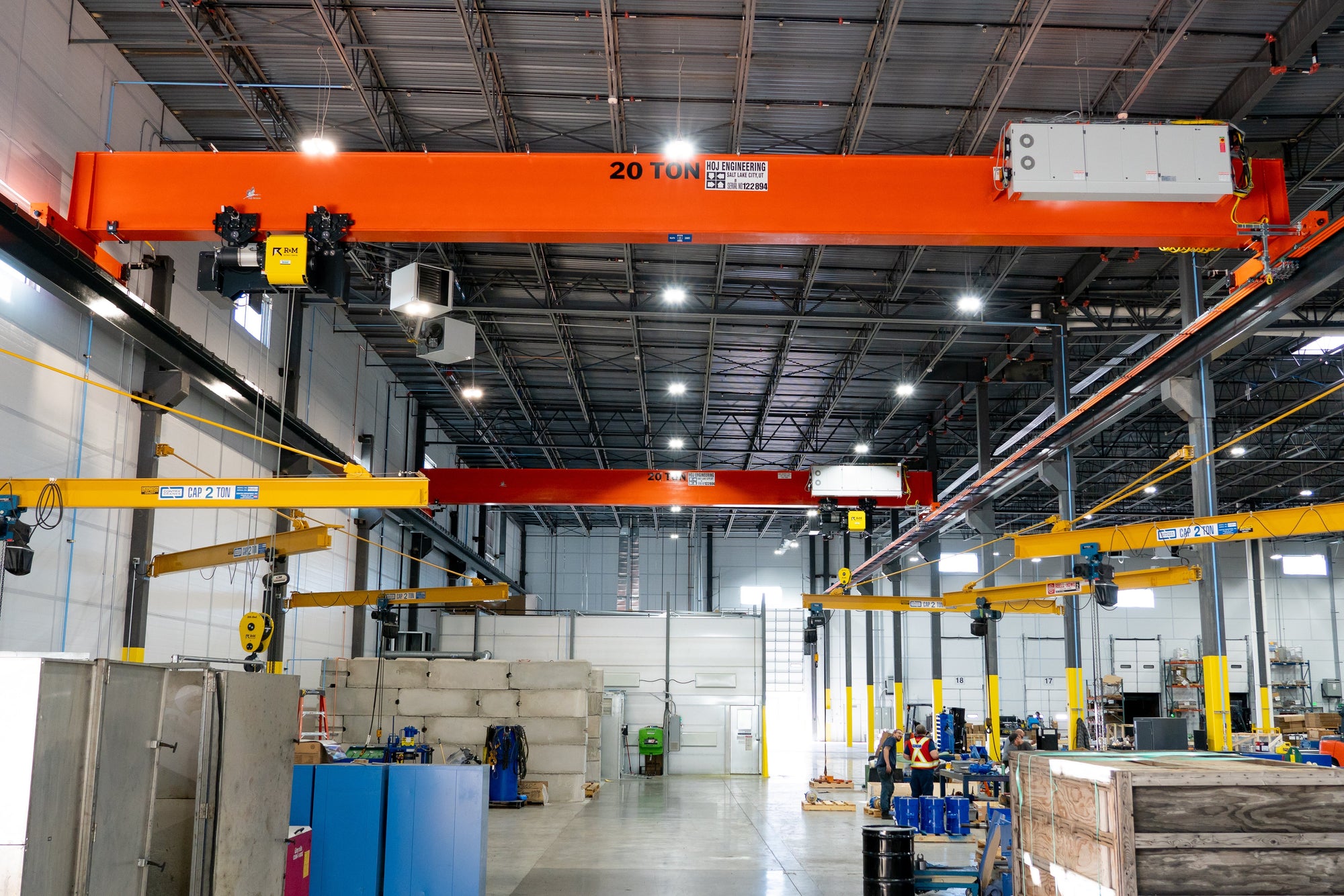
Choose a jib crane when the work is concentrated, repetitive, and tied to a fixed point: a press loaded dozens of times a shift, or an assembly cell moving identical parts between two points. A jib is the lowest-cost way to pull one manual lift out of one workstation. It can also act as an auxiliary lifting device under a bridge crane, so the bridge handles bay-wide moves while the jib takes short, frequent picks.
The mounting decision sets reach, capacity, and floor space. Common configurations include the following.
|
Jib type |
Capacity |
Reach |
Rotation |
Foundation |
|
Freestanding |
Up to 15 tons |
Up to 50 ft |
360 degrees |
Engineered foundation (typically reinforced concrete) |
|
Mast-style |
Typically up to 5 tons |
Up to 20 ft |
360 degrees |
Adequate floor slab and overhead tie point |
|
Wall-mounted |
Typically up to 5 tons |
Up to 20 ft |
180 to 200 degrees |
Adequate wall or column |
|
Articulating |
Up to 1 ton |
Up to 16 ft |
Varies, up to 360 degrees on both booms |
Depends on mounting choice |
A freestanding jib gives the widest reach and heaviest capacity but needs i ts own foundation. Wall-mounted and mast-style jibs cost less and consume no floor space, trading away rotation and reach, and they depend on the host structure being strong enough. An articulating jib uses two jointed booms to reach around corners, columns, and obstructions and into the dead zone close to the mast, with capacity typically capped near 1 ton.
When a Bridge Crane Wins
An overhead bridge crane earns its higher cost when work spreads across an area instead of sitting at a point. Pick a bridge crane for full-bay coverage, for serving several cells with one system, for moving loads across a bay, and for loads beyond jib range. Once loads pass 20 tons or you lift near rated capacity many times a day, the double-girder bridge crane is the configuration that scales.
A third option sits between them. An enclosed-trackworkstation crane gives rectangular, bay-style coverage at light capacity. Aluminum-track versions weigh significantly less than trussed steel and roll easier than a traditional bridge crane, which is why they dominate light-load assembly cells where reducing operator push-pull force matters most.
A jib crane is usually the cheapest way to remove a manual lift. Across the projects HOJ quotes, jib crane equipment costs typically range into the low tens of thousands, with installation adding a similar order of magnitude once freight, the foundation pour, wiring, and load testing are counted.
A bridge crane is a larger commitment. Single-girder systems serve moderate spans and capacities at a meaningfully higher price point than jibs, and double-girder systems scale from there. The line item buyers underestimate most is the foundation. A freestanding jib needs reinforced concrete, which can rival or exceed the cost of the crane itself. Wall-mounted and mast-style jibs avoid the pour, making the mounting decision a budget decision.
Jib vs Overhead Decision Table
Match the equipment to the job. Point work goes to a jib; area work goes to a bridge.
|
Scenario |
Best fit |
Why |
|
Repetitive lift at one workstation |
Jib crane |
Circular coverage at a fixed point |
|
Machine tending at a press or tool |
Jib crane |
Targeted lift, no full bay needed |
|
Full-bay coverage of a production area |
Overhead bridge crane |
Rectangular coverage of the whole bay |
|
Several cells served by one system |
Overhead bridge crane |
One bridge reaches every cell |
|
Load transfer across a bay |
Overhead bridge crane |
Moves loads corner to corner |
|
Light loads, bay coverage, ergonomics first |
Enclosed-track workstation crane |
Bay coverage with low push force |
|
Reaching around columns or obstructions |
Articulating jib crane |
Jointed booms reach the dead zone |
Specs, Duty, and Standards
Jib crane capacity follows a convention that surprises first-time buyers. The jib design load equals rated capacity, plus 15% for the hoist and trolley, plus 25% for impact. The rating builds in margin, so the applied load should never exceed rated capacity. Size the crane above your heaviest lift, not exactly to it.
Duty cycle is the spec teams skip most. The Hoist Manufacturers Institute and ASME classify hoists by load and run time: H2 covers light service under 12.5% of the work period, H3 standard service up to 25%, and H4 heavy service with frequent near-rated loads. A busy jib can need an H3 or H4 hoist while a lightly used bridge crane needs only H2.
Standards differ by configuration. Top-running overhead and gantry cranes fall underOSHA 1910.179 and the consensus standardASME B30.2. Jib cranes have no dedicated OSHA crane rule. As underhung equipment they fall underASME B30.17, which explicitly covers jib cranes, while the trolley hoist falls underASME B30.16. Knowing which standard applies keeps your inspection and testing program defensible.
Most Facilities Need Both
Many facilities do not choose one. A bridge crane handling bay-wide moves with jib cranes underneath it for point-of-use lifts is a common, efficient layout. The payoff is measurable:OSHA's business case for safety, citing Liberty Mutual's Workplace Safety Index, puts disabling workplace injuries at more than $1 billion per week in direct workers' compensation costs, with overexertion from manual material handling consistently ranked the top cause. Every lift a crane removes is a lift that cannot strain a back.
Start with the workflow. HOJ Innovations' space utilization engineers can map your lift patterns, capacities, and building structure, then recommend the right mix of equipment through a 3D Strategic Planning consultation. Choosing the right lifting solution is one more way to make more of your space.