

Your Cart is Empty





Vertical Spiral Conveyor
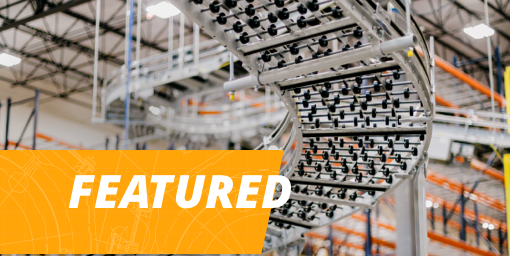
A vertical spiral conveyor moves cartons, totes, and cases continuously up or down a helical belt wrapped around a central column. Unlike a reciprocating lift that carries one load at a time, the spiral keeps product flowing without batching, in a footprint up to 75 percent smaller than an incline conveyor. Elevation reaches 100 feet.
Key facts
• Moves product continuously up or down, no batching
• Elevation capacity up to 100 ft vertical
• Speeds 30 to 120 FPM with gentle acceleration and deceleration
• Belt widths 12 to 48 in.; loads up to 40 lbs per foot
• Diameters 5 to 12 ft depending on load and elevation
• Saves up to 75 percent floor space versus incline conveyor
How does a vertical spiral conveyor work?
A vertical spiral conveyor wraps a continuous belt or slat chain in a helix around a central drive column. A single gearmotor turns the belt, and product rides the helical path from the infeed at one elevation to the discharge at another, rising or descending without stopping. Because the belt runs continuously, cartons enter and exit in a steady stream rather than waiting for a platform to cycle, which is the core difference between a spiral and a reciprocating vertical lift. Gentle acceleration and deceleration at the transfer points keep product stable, and single- or dual-helix configurations serve one or multiple levels.
Vertical spiral conveyor specifications
| Specification | Vertical spiral conveyor |
| Flow type | Continuous, no batching |
| Elevation capacity | Up to 100 ft vertical |
| Speed | 30 to 120 FPM |
| Belt width | 12 to 48 in. |
| Load capacity | Up to 40 lbs per foot |
| Diameter | 5 to 12 ft |
| Footprint vs. incline | Up to 75% less floor space |
| Configurations | Single or dual helix, left/right rotation |
| Safety | Enclosed guarding, access gates, OSHA-compliant |
Where are vertical spiral conveyors used?
• Feeding cartons and totes to and from mezzanines
• Parcel, fulfillment, and distribution lines between floors
• Connecting pick modules to overhead or shipping conveyor
• Bottling and canning lines (mass-flow spirals)
• Moving product over traffic aisles or work platforms
• Any continuous-flow line with an elevation change and tight floor space
Spiral, vertical lift, or incline conveyor?
Three ways to change elevation, three tradeoffs. An incline conveyor is the cheapest but consumes the most floor space. A reciprocating vertical lift has the smallest footprint but batches product one load at a time, creating downstream gaps. A vertical spiral conveyor keeps product flowing continuously in a compact footprint, costs more upfront than an incline, and is sized for unit loads, not pallets. Choose the spiral when continuous throughput and floor space both matter.
Plan a vertical spiral conveyor
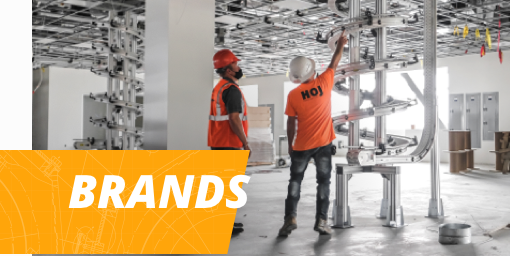
HOJ engineers and integrates vertical spiral conveyors as an authorized Hytrol Integration Partner, sizing the spiral to your product, throughput, and ceiling height, then installing and servicing it from regional service infrastructure. Talk to a conveyor specialist.
Testimonials
READY TO GET STARTED?
REACH OUT TO US TODAY
Whether it’s a project, product, repair or service, let’s chat to see if we can make your warehouse operations more efficient.
READY TO GET STARTED?
REACH OUT TO US TODAY
Whether it’s a project, product, repair or service, let’s chat to see if we can make your warehouse operations more efficient.