

Your Cart is Empty





Spiral Roller Conveyor
Spiral Roller Conveyor
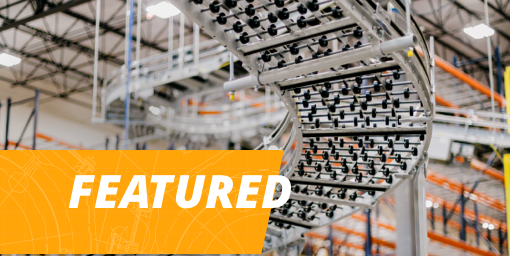
A spiral roller conveyor lowers product down a helical path on rotating rollers instead of a solid slide surface or a driven belt. Product rolls rather than slides, which changes what it can carry, how fast it arrives, and how it behaves in the turn. HOJ builds gravity roller conveyor systems with curves and spurs as part of larger lines.
The engineering that makes a roller spiral work is not the helix. It is the rollers.
Why the Rollers Are Tapered
Every curve creates a speed problem. The outside edge of a carton has to travel a longer arc than the inside edge to get through the same turn. Straight cylindrical rollers drive both edges at the same surface speed, so the outside of the load falls behind, the carton skews, and it wedges against the guardrail.
Tapered rollers fix it geometrically. The roller is a cone, larger in diameter at the outer rail and smaller at the inner rail. Because the roller turns as one piece, the larger outer diameter covers more distance per revolution than the smaller inner end, and that difference matches the difference in arc length. The carton tracks through the turn square instead of walking into the rail.
The ratio matters. Roller diameter has to scale with radius across the bed, so a tight spiral with a narrow inner radius needs a more aggressive taper than a wide one. Get the taper wrong and the symptoms show up as skewing, corner scuffing, and jams at the discharge rather than anywhere obvious.
Skatewheel is the alternative at light weights. Independent wheels each turn at their own speed, so they accommodate the differential without tapering, and they track better through curves than straight rollers.
Roller, Chute, or Powered Belt
Three ways to get product down a helix, and they are not interchangeable.
| Spiral roller | Spiral chute | Powered spiral | |
|---|---|---|---|
| Surface | Rotating rollers or wheels | Continuous low-friction slide | Driven belt or slat |
| Power | None, gravity | None, gravity | Motorized |
| Direction | Down | Down | Up or down |
| Product needs | Firm flat bottom | Tolerates bags and irregular bottoms | Most unit loads |
| Speed control | Pitch, roller spacing, brakes | Slope and surface friction | Belt speed, metered |
| Maintenance | Bearings, roller replacement | Almost none | Drive, belt, chain service |
The deciding question is usually the bottom of the product, not the drop height.
What Can Actually Ride Rollers
This is where roller spirals get specified wrong most often.
Product needs a firm, flat bottom long enough to span at least three rollers at all times, or it dives between them. Roller centers follow product length, so the shortest item on the line sets the spacing, not the average one.
That rules out a category of product outright. Polybags, pouches, soft packs, and anything with a sagging or irregular bottom will not track on rollers regardless of how well the spiral is built. Those belong on a gravity spiral chute, which handles cartons, totes, polybags, pouches, and corrugated together.
If your mix includes both rigid cases and soft packs, decide which one the spiral serves before you pick the surface.
Controlling Speed on the Way Down
A gravity roller spiral accelerates. Product entering at the top picks up speed continuously through the descent, and a case arriving at the discharge faster than the takeaway line can absorb it becomes damage, a jam, or both.
On gravity lines generally, most products convey with a minimum amount of pitch, and the right pitch follows product weight and roller spacing. On a spiral that principle gets harder, because the helix angle is fixed by the geometry and the drop height, and heavier product accelerates faster than light product on the identical path.
The practical controls are roller spacing, brake or speed-reducing rollers positioned through the descent, and a discharge section that is metered rather than free-running. A mixed-weight product profile is the case that needs the most attention, because a single pitch has to work for both the lightest and heaviest item.
Load, Frame, and Roller Class
Roller class follows the load. Gravity rollers run 1-3/8 in for light duty, 1.9 in standard, and 2-1/2 to 2-5/8 in for heavy duty.
On a spiral, load also concentrates differently than on a straight run. The outer rail carries more of the load through the turn as product settles outward, which affects rail height, guard design, and how the frame is supported through the helix.
Gravity sections have no motorized parts, so lines set up, extend, and move without electrical work. That makes a roller spiral genuinely relocatable in a way a powered spiral is not, which matters in leased buildings and seasonal layouts.
Where Roller Spirals Fit
Mezzanine and platform let-down. Bringing cases from an upper level to floor-level pack or ship without a powered spiral.
End of line to shipping. Dropping completed cases to a takeaway lane or dock area.
Receiving and unloading. Moving product down from an elevated infeed.
Returns drop points. Getting cases down to a processing area without adding drive or controls.
The common thread is down-only flow with rigid product and no requirement to meter rate. Where any of those change, a powered spiral conveyor is usually the right answer instead.
Why Operations Bring HOJ In
A spiral roller conveyor looks like the simplest machine in the building, and that is exactly why it gets specified from a catalog and then underperforms. Taper, pitch, roller spacing, and discharge control all have to agree with your actual product mix, and a spiral that was sized for the average case will fail on the lightest and heaviest ones.
HOJ has engineered material handling since 1964, and we take the whole scope so nobody is left holding a gap.
We spec against your product, not a catalog page. HOJ is an authorized Hytrol Integration Partner and evaluates other proven manufacturers when the application calls for it, so the surface, taper, and pitch are matched to what you actually run.
We design the whole flow, not one piece. A spiral is a transition between two lines, and the infeed and takeaway decide whether it works. HOJ engineers conveyor and controls together in-house rather than handing the electrical to a subcontractor.
Our own crews install it, and outside engineers check it. In-house teams cover the mechanical and electrical work without subcontractors, installers include veterans with more than 20 years on conveyor, and the finished work is reviewed by independent third-party engineers and safety inspectors.
We stand behind it and stay after startup. A one-year warranty on installation quality plus manufacturer warranties, backed by locally stocked parts and a 70-plus vehicle service fleet.
We can also work a new spiral into a line running older equipment, so adding one does not mean replacing what is around it.
Book an assessment with an HOJ engineer. You get a working session with someone who designs, installs, and services these systems, not a rep reading off a spec sheet.
Testimonials
READY TO GET STARTED?
REACH OUT TO US TODAY
Whether it’s a project, product, repair or service, let’s chat to see if we can make your warehouse operations more efficient.
READY TO GET STARTED?
REACH OUT TO US TODAY
Whether it’s a project, product, repair or service, let’s chat to see if we can make your warehouse operations more efficient.