

Your Cart is Empty





Overhead Conveyor Systems
An overhead conveyor system moves product on trolleys or pendants riding a ceiling-mounted track, freeing the floor below for people and equipment. The two main types are monorail, where every carrier moves at the same speed on one track, and power and free, where carriers stop, accumulate, and route independently.
Quick Facts
Two main types. Monorail for fixed-sequence continuous flow; power and free for accumulation and routing.
Track styles. Enclosed tubular track or 3, 4, and 6 in I-beam.
Capacity. Jervis Webb power and free components carry 5 lbs to 20,000 lbs per carrier.
Drive. A single motor powers 700 to 800 ft of conveyor.
Inverted option. Floor-mounted inverted lines carry product above the chain, keeping drips off painted parts.
How does an overhead conveyor system work?
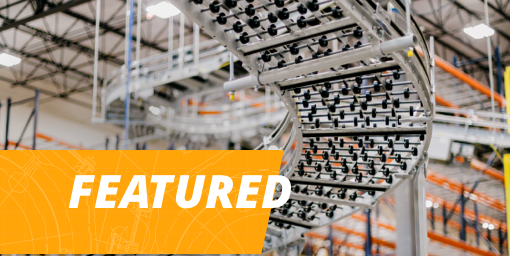
A continuous chain runs inside the track, and pendants or load bars hang from it at fixed intervals, carrying parts on hooks or custom carriers. On a monorail, every carrier rides the chain directly, so the whole line moves at one speed through assembly, wash, paint, and cure. On a power and free conveyor, the powered chain runs on an upper track while trolleys ride a free track below it; dogs on the chain engage and release the trolleys, so individual loads stop at stations, queue in banks, switch between spurs, and re-enter the flow without stopping the line. Vertical curves carry the track between elevations, putting work-in-process overhead instead of on the floor.
Overhead Conveyor Types
| Type | Track and movement | Typical use |
| Monorail | Single track, all carriers at one speed | Paint lines, curing ovens, fixed-sequence assembly |
| Power and free | Dual track, powered chain over free trolley track; carriers stop and route independently | 5 lbs to 20,000 lbs per carrier (Jervis Webb components); sequencing and buffering |
| Enclosed track | Tubular rail encloses the chain | Protects chain from dust and overspray; quiet; medium loads (Unibilt-class systems) |
| I-beam | 3, 4, or 6 in I-beam with chain and trolleys | Heavy loads, demanding environments |
| Hand push | Unpowered enclosed track or I-beam | Manual moves and light buffering |
| Inverted | Floor-mounted, product above the chain | Paint and finishing lines where drips cannot touch product |
| Standards | ASME B20.1 design and operation; OSHA 1910.212 and 1910.219 guarding | |
What is the difference between monorail and power and free conveyors?
A monorail moves every carrier at the same speed along one fixed route, which makes it the simpler, lower-cost system for lines where the sequence never changes. Power and free separates the chain from the load: carriers stop independently, accumulate in queues, and route across spurs while the chain keeps running. Choose monorail for steady single-path flow; choose power and free when stations run at different rates or loads need sequencing.
What are overhead conveyors used for?
Paint and powder lines. Carrying parts through pretreatment, coating, and curing ovens in one continuous path.
Assembly. Delivering components along automotive and equipment lines without floor traffic.
Metals fabrication. Moving welded and finished parts between processes.
Buffering. Storing work-in-process overhead instead of in floor staging.
Garment and e-commerce. Hanging-goods transport and sortation.
Why move product overhead instead of on the floor?
Floor space is the scarcest resource in most plants, and an overhead conveyor system gives it back: the transport path occupies ceiling structure instead of aisles. Product travels through ovens, wash booths, and between mezzanine levels in one continuous path no floor conveyor can follow, handling stays gentle because parts hang rather than stack, and a single drive moving hundreds of feet of chain replaces forklift trips between every process.
Plan Your Overhead Conveyor System
HOJ engineers overhead conveyor systems in-house, from track routing and structural supports through controls and installation, building material handling systems since 1964. Talk to a conveyor specialist today.
Testimonials
READY TO GET STARTED?
REACH OUT TO US TODAY
Whether it’s a project, product, repair or service, let’s chat to see if we can make your warehouse operations more efficient.
READY TO GET STARTED?
REACH OUT TO US TODAY
Whether it’s a project, product, repair or service, let’s chat to see if we can make your warehouse operations more efficient.