

Your Cart is Empty





Mat Top Conveyor
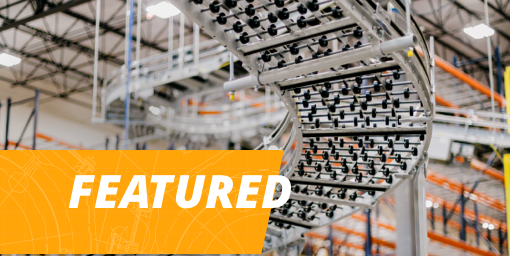
A mat top conveyor moves product on a wide modular plastic belt built from linked plastic mats. The side-turning belt carries cases, jars, trays, and packaged goods around curves and spirals in a single continuous run, so a winding, multi-direction layout needs no transfer points or dead plates between sections.
Mat top conveyor at a glance
A mat top conveyor runs a corrosion-resistant modular plastic belt across the full width of the frame, carrying product in mass flow rather than a single lane. Its defining trait is side-turning construction: the modular plastic belt follows curves and spirals in minimal floor space, so one belt routes product through turns, straights, metering, inclines, and declines without breaking the line. Belt surface options include flat top, radius, friction top, and low-back-pressure roller top, each matched to the product. The belt is easy to clean and low maintenance, and sanitary and washdown versions meet food safety standards. Mat top differs from table top, which is a narrow flat-top chain for single-file containers rather than full-width flow.
How does a mat top conveyor work?
A mat top conveyor drives an endless modular plastic belt, assembled from interlocking plastic modules, over a wear surface and sprockets. Because the modules hinge in more than one direction, the belt flexes around horizontal curves and over elevation changes while presenting a continuous flat carrying surface across its full width. Product rides directly on the belt in mass flow. A single mat top conveyor can therefore route product through a layout with curves and spirals that would otherwise require several straight conveyors joined by transfers. When a module wears or breaks, that section is replaced rather than the whole belt, which lowers maintenance cost over a fabric belt.
Mat top conveyor specifications
Verified against Nercon MatTop product data. Final configuration is engineered to the product, line speed, and sanitation environment.
| Specification | Detail |
| Belt | Corrosion-resistant modular plastic belt |
| Construction | Side-turning, follows curves and spirals |
| Belt surfaces | Flat top, radius, friction top, roller top |
| Layout | Curves, straights, metering, inclines, declines |
| Configurations | Standard, low-profile, and sanitary |
| Curve tech | Zero Tangent Radius, constant inner radius |
| Transfers | Dynamic Transfer Section, live transfer, no dead plates |
| Maintenance | Replace worn modules, not the whole belt |
Where are mat top conveyors used?
Packaging lines. Carrying cases, trays, and packaged goods of varied sizes in mass flow.
Curved and spiral layouts. Routing product through turns and elevation changes on one belt.
Sanitary food and beverage. Washdown and clean-design lines that meet food safety standards.
Accumulation and metering. Buffering and pacing product between upstream and downstream equipment.
Tight floor spaces. Low-profile belts that integrate into existing lines without major changes.
What is the difference between mat top and table top?
A mat top conveyor uses a wide modular plastic belt to move product across the full belt width in mass flow, and it turns curves and spirals on one belt. A table top conveyor uses a narrow flat-top chain to move containers in a single lane. Choose mat top when product moves in mass across the width or the layout needs curves and spirals. Choose table top for single-file containers like bottles and cans. Both are unit-handling systems, not bulk conveyors.
Plan a mat top conveyor
HOJ engineers and integrates mat top conveyors as an independent integrator, pairing Nercon and FMH modular plastic belt platforms with your product, layout, and sanitation requirements. Talk to a specialist.
Testimonials
READY TO GET STARTED?
REACH OUT TO US TODAY
Whether it’s a project, product, repair or service, let’s chat to see if we can make your warehouse operations more efficient.
READY TO GET STARTED?
REACH OUT TO US TODAY
Whether it’s a project, product, repair or service, let’s chat to see if we can make your warehouse operations more efficient.