
Your Cart is Empty







Overhead Crane Runway Alignment: Warning Signs, Causes, and How to Prevent Costly Damage

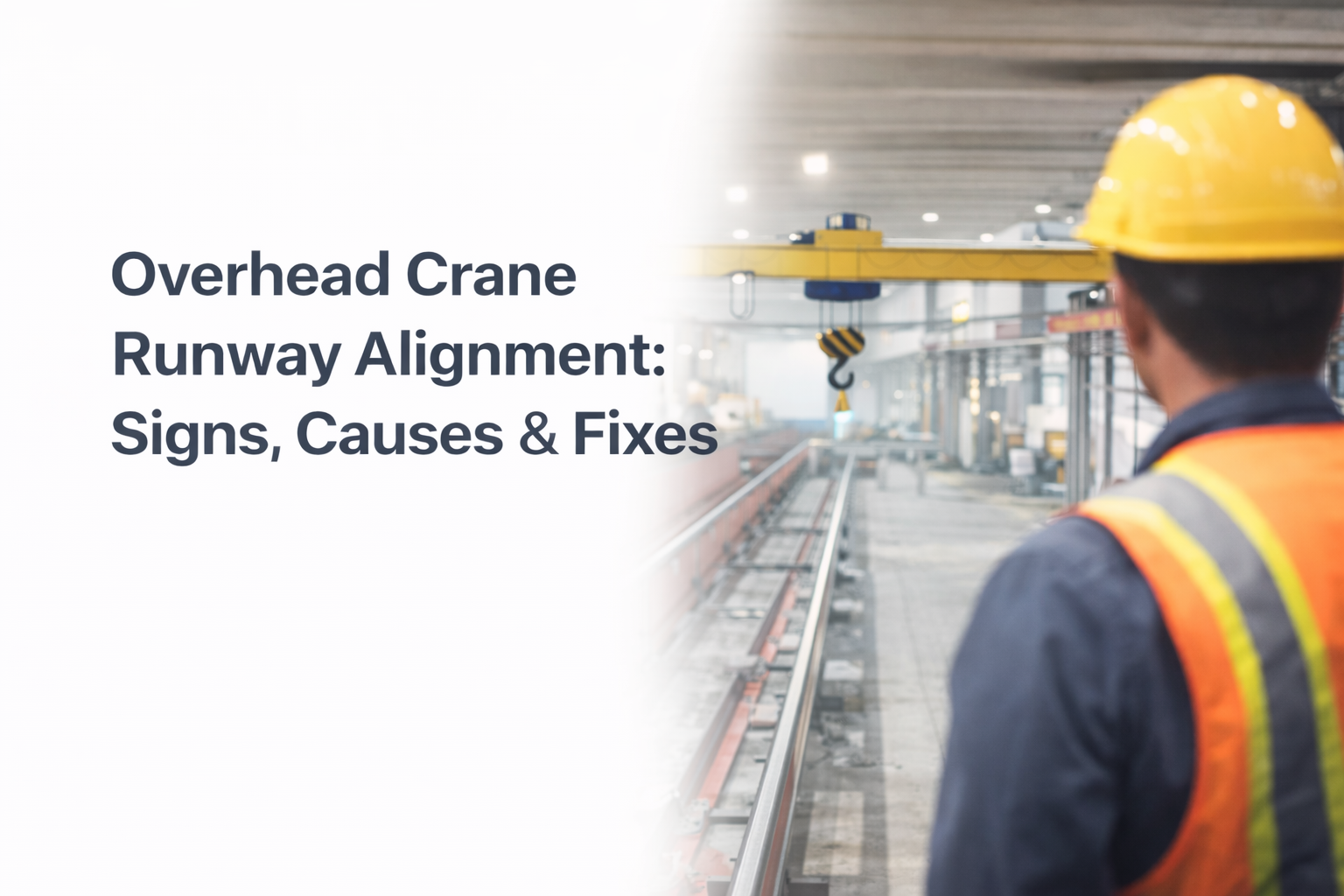
Poor overhead crane runway alignment ranks among the most common and damaging crane problems in industrial facilities. It is also one of the most expensive when left unchecked. A single misaligned rail can generate over 200 pounds of lateral force on awheel flange with every rotation, grinding away at wheels, bearings, end trucks, and motor drives until something breaks. The damage is progressive: misalignment accelerates wear, and wear accelerates misalignment.
WithSection 232 steel tariffs hitting 50% as of April 2026, the cost of replacing crane components damaged by neglected runway alignment has climbed sharply. Tariff-driven material costs have increased overall constructionproject expenses by 4-6%, making every premature wheel swap and end truck repair more painful on the budget. Catching runway misalignment early is no longer just good maintenance practice. It is a financial necessity.
This article breaks down the warning signs of crane runway alignment problems, the root causes behind them, CMAA runway alignment tolerances you should know, what a runway survey involves, and the real costs of doing nothing.
Table of Contents
-
Why Overhead Crane Runway Alignment Matters More Than Most Facilities Realize
-
Warning Signs Your Crane Runway Is Out of Alignment
-
What Causes Crane Runway Misalignment
-
CMAA Runway Alignment Tolerances and Deflection Limits
-
How a Crane Runway Survey Works
-
The Real Cost of Ignoring Runway Alignment
-
How to Prevent Crane Runway Alignment Problems
-
Key Takeaways
Why Overhead Crane Runway Alignment Matters More Than Most Facilities Realize
When crane rails drift out of alignment, the bridge crane no longer travels in a clean, parallel path. Instead, the crane skews. A slip angle develops between the crane axles and the runway axis, generating lateral loads on wheel flanges that the system was not designed to absorb continuously.
With just one degree of skew on a single wheel, lateral flange forces exceed200 pounds per rotation. That force produces microscopic steel flaking on the flange and rail edge, which leads to vibration, motor strain, and bearing overheating within months. The damage compounds from there. Premature wheel wear, stressed bearings, and vibration-loosened rail clips all feed back into the runway, pushing rails further out of alignment.
This self-reinforcing cycle is why crane runway alignment problems rarely stay small. Loose rail clips allow rails to shift under load, creating progressive misalignment and escalating structural stress. One side of the crane absorbs excessive wheel loads while the other is underloaded, concentrating damage on specific wheels, bearings, and rail edges.
The endpoint of that cycle is severe. Replacement of long runs of runway rail from misaligned runways can cost more than replacing the bridge cranes themselves. That is not a hypothetical. It is a documented reality that facilities discover after years of deferred runway maintenance.
Warning Signs Your Crane Runway Is Out of Alignment
Visual and Audible Indicators
The earliest signs of crane rail misalignment causes are often visible and audible on the shop floor. Metal shavings or steel filings accumulating on runway beams, columns, or the floor beneath the crane path indicate flange-to-rail contact that should not be happening. Scraping, scratching, or grinding noises during bridge travel confirm it. Visible flange wear appears as measurable thickness loss, sharp or burred flange edges, or asymmetric wear between the two sides of the wheel, any of which indicates sustained lateral contact with the rail.
Crane drift is another telltale sign. If the bridge pulls to one side during travel without operator input, the runway rails are likely out of parallel. Visible gaps between the wheel flange and rail on one side, while tight on the other, point to the same issue.
Performance Indicators
Beyond what you can see and hear, overhead crane tracking problems show up in how the crane moves. Jerky or unsmooth bridge travel, abnormal vibration during crane movement, and motors that seem to strain harder than they should all indicate the crane is fighting its own runway. Wheel overheating, detected by touch or thermal monitoring, signalsexcessive friction from misalignment.
Warning Signs Reference Table
|
Warning Sign |
Likely Cause |
Recommended Action |
|
Metal shavings on runway beams or floor |
Wheel flange scraping rail edge due to lateral misalignment |
Schedule a crane runway survey; inspect wheel flanges for wear |
|
Scraping or grinding noises during travel |
Rail-to-rail span out of tolerance; crane skewing |
Measure rail gauge at multiple points; check for loose rail clips |
|
Crane drifts to one side |
Rails not parallel; differential elevation between rails |
Full runway alignment survey; check column plumb |
|
Visible flange wear (shiny worn edges) |
Sustained lateral forces from misaligned rails |
Measure flange thickness against replacement criteria; survey runway |
|
Jerky or unsmooth bridge movement |
Rail straightness deviation; rail joint misalignment |
Inspect rail joints and fasteners; check rail straightness |
|
Wheel or bearing overheating |
Excessive friction from crane skewing on misaligned runway |
Immediate inspection; check alignment and wheel condition |
|
Abnormal vibration during travel |
Rail joint gaps; rail surface irregularities; wheel flat spots |
Inspect runway beam condition; check deflection under load |
|
Uneven rail wear patterns |
One rail higher or more offset than the other |
Survey rail-to-rail elevation; check foundation settlement |
Beyond visual signs, measurable wheel wear is the most reliable benchmark for action. Flange thickness loss, asymmetric flange wear, tread spalling, and out-of-round conditions all signal that the wheel has reached its service limit. Specific wear limits should follow the crane manufacturer's maintenance manual and applicable CMAA or ASME B30.2 guidance.
What Causes Crane Runway Misalignment
Foundation and Structural Causes
The most common crane rail misalignment causes originate in the building structure itself. Differential foundation settlement between supporting columns is a primary driver. When one column settles more than its neighbor, the rail it supports drops with it, throwing off rail-to-rail elevation and introducingmisalignment and loose fastener risk across the runway system.
Column deflection under repeated crane loading cycles is another structural culprit. Every time the crane picks up a load, the runway columns absorbvertical, lateral, and longitudinal forces. Excessively flexible columns cause changes in rail-to-rail gauge under load, and thousands of loading cycles can drive fatigue cracking in welds, bolts, and connections, all of which compromise alignment over time.
Runway beam fatigue is a long-term concern, particularly in heavy-duty applications. Fatigue cracks in welded crane runway girders have been documented worldwide, with cracks forming at the web-to-top-flange juncture. In one case, end-coped crane runway girders in a Chinese steel milldeveloped fatigue cracks after just 14 years of service.
Operational Causes
Crane overloads cause permanent deflection in runway beams that changes the alignment geometry. Repeated high-speed travel compounds the effect, particularly in facilities running Class D or higher duty cycles with 10-20+ lifts per hour at or near rated capacity.
Environmental and Installation Causes
Thermal expansion and contraction cycling is an underappreciated factor. A runway that binds under thermal expansion will push columns out of alignment, overload connections, andshift rail position. Insufficient runway stiffness makes this worse, as documented in a 2017 case study where a two-bay industrial steel hall built in 2014 experiencedload-bearing joint failures immediately after commissioning due to an overly lightweight design that lacked sufficient rigidity.
Poor original installation accounts for a significant share of early-onset alignment problems. Installations that skip proper laser alignment, load testing, and CMAA compliance often require costly corrective retrofits within months, including wheel, end truck, and bearing replacements that can run tens of thousands of dollars.
CMAA Runway Alignment Tolerances and Deflection Limits
The Crane Manufacturers Association of America (CMAA) Specification 70 defines the tolerances that every overhead crane runway alignment must meet.Table 1.4.2-1 provides the specific limits:
CMAA 70 Rail Alignment Tolerances (Table 1.4.2-1)
|
Measurement |
Spans < 50 ft |
Spans 50-100 ft |
Spans > 100 ft |
|
Rail-to-rail span deviation |
±3/16 in. |
±1/4 in. |
±3/8 in. |
|
Rail-to-rail elevation |
±3/16 in. |
±1/4 in. |
±3/8 in. |
|
Rail straightness (each rail from centerline) |
±3/8 in. |
±3/8 in. |
±3/8 in. |
|
Rate of change (max variation over any 20 ft) |
1/4 in. |
1/4 in. |
1/4 in. |
The rate of change tolerance is particularly important for facility managers to understand. Even if both rails fall within overall straightness limits, a sudden 1/4-inch jog over a short distance creates a localized lateral force spike that hammers wheel flanges and end truck connections every time the crane passes through that zone.
Deflection Limits by CMAA Service Class
Crane runway beam deflection limits vary based on how hard the crane works. CMAA Specification 70 sets vertical deflection limits relative to therunway girder span (L):
|
CMAA Service Class |
Application Examples |
Vertical Deflection Limit |
Lateral Deflection Limit |
|
Class A/B (Standby/Light) |
Power plants, repair shops, light warehousing |
L/600 |
L/400 |
|
Class C (Moderate) |
Machine shops, 50% avg. capacity, up to 10 lifts/hr |
L/600 |
L/400 |
|
Class D (Heavy) |
Foundries, container yards, 10-20 lifts/hr |
L/800 |
L/400 |
|
Class E/F (Severe/Continuous) |
Scrap yards, cement mills, 20+ lifts/hr near max capacity |
L/1000 |
L/400 |
Lateral deflection is capped at L/400 across all classes, calculated based on 10% of maximum wheel loads withoutvertical inertia forces. For a 40-foot runway girder span, that means the lateral deflection limit is 1.2 inches. For a Class E crane on the same span, vertical deflection must stay under 0.48 inches.
These numbers matter because they define the threshold between a runway that is performing within design parameters and one that is actively damaging your crane. If your last crane runway survey showed measurements approaching these limits, the next survey should not wait.
How a Crane Runway Survey Works
A crane runway survey measures the geometric condition of your runway system against CMAA tolerances. A thorough survey captures top-of-beam elevation at each column and mid-span, rail straightness (lateral alignment), rail gauge (span between rails), rail-to-rail elevation differential, rail joint conditions and gaps, fastener condition (rail clips and bolts), column plumb, and rate of change along thefull runway length.
Survey Technologies
Traditional methods use total station instruments, laser alignment tools, or the piano wire method to establish true straight reference lines along each rail. LiDAR technology has improved accuracy for mapping both vertical andhorizontal alignment.
The most significant advancement in crane runway survey technology is 3D laser scanning. Modern high-definition scanning systems can measure the 3D position and cross-section of crane rails, rail joints, and rail fastenings in asingle pass. These remotely operated systems can survey most runway systems within a single shift, significantly reducing downtime compared to traditional methods that required multiple technicians working at height for extended periods. The remotely operated data collection also eliminates the need for personnel to work on top of the rails, improving safety while delivering more comprehensive geometric data for analysis.
How Often to Survey
The Occupational Safety and Health Administration (OSHA) standard 1910.179(j) requiresperiodic inspections at 1-to-12-month intervals based on crane activity, severity of service, and environment. Deformed, cracked, or corroded members are specifically called out for inspection. ASME B30.2 refines this further, withperiodic inspections occurring annually, semi-annually, or quarterly depending on the crane's frequency of use, handled load characteristics, and operating environment.
A practical crane runway inspection checklist should include annual surveys for Class A-C cranes and semi-annual surveys for Class D and above. Any facility that observes the warning signs listed earlier should schedule an immediate survey regardless of the regular interval.
The Real Cost of Ignoring Runway Alignment
The financial case for proactive overhead crane runway alignment monitoring is built on hard numbers.
Component replacement costs: What replacement costs actually look like depends on the crane, the duty cycle, and how long misalignment has gone uncorrected. In our experience, the failure sequence is predictable: wheels and bearings go first, then end trucks, then motor drives and couplings. Catch it early, and you're replacing a pair of wheels. Catch it late, and you're looking at rail replacement, which on a long runway frequently exceeds the cost of replacing the bridge crane itself, plus weeks of production downtime while the work gets done.
Downtime costs: In steel mill and heavy industrial applications, a crane breakdown can cost tens of thousands of dollars per hour in lost production, with material handling failures creating disproportionate production impact because they disrupt the flow betweenmultiple production units. Even in lighter-duty environments, unplanned crane downtime disrupts material flow, delays production, and forces manual workarounds that drive up labor costs.
Lifecycle maintenance impact: Where a crane lands on the maintenance cost curve over its operating life is driven by duty cycle, operating environment, and how well alignment and preventive maintenance are managed. Light-duty cranes in clean manufacturing environments sit at the low end. Heavy-duty cranes in steel mills, foundries, and ports running 24/7 sit at the high end, where continuous operation, thermal cycling, and abrasive conditions accelerate every form of wear. Runway misalignment is one of the biggest swing factors determining where a facility lands. Every component failure avoided through alignment monitoring compounds into meaningful reductions in long-term maintenance spend.
2026 tariff escalation: With 50% tariffs on steel goods and 25% on steel derivatives now in effect, every replacement wheel, end truck, rail section, and structural repair costs significantly more than it did two years ago. Nonresidential construction input prices rose at a 7.1% annualized rate in early 2026, with theENR Building Cost Index up 4.2% year-over-year. Proactive alignment monitoring is the most direct way to defer these inflated replacement costs.
Regulatory exposure: Regulatory exposure: OSHA penalties for serious crane safety violationsreach $16,550 per instance, with willful violations carrying fines up to $165,514. An unsafe runway condition identified during an OSHA inspection that has not been corrected violates1910.179(l)(3), which requires that any unsafe conditions disclosed by inspection be corrected before the crane resumes operation.
How to Prevent Crane Runway Alignment Problems
Preventing runway misalignment is not about a single fix. It requires a systematic approach tied to your crane's duty classification and your facility's operating environment.
Establish a survey schedule based on duty class.Industry inspection frameworks built around ASME B30 and OSHA 1910.179 recommend monthly checks on runway rails for alignment, wear, joint gaps, and fastener condition, with a comprehensive annual inspection by a qualified person. Facilities running Class D or higher cranes should increase survey frequency beyond these baselines. Document every measurement and track trends over time. A rail that has shifted 1/8 inch in two years will shift further.
Monitor warning signs between formal surveys. Train crane operators and maintenance staff to recognize and report metal shavings, unusual noises, drift, vibration, and wheel overheating. These observations between surveys catch developing problems before the next scheduled measurement.
Address root causes, not just symptoms. When a survey reveals misalignment, investigate the source. Shimming a rail back into position does nothing if the column beneath it is settling or deflecting. Foundation repairs, connection reinforcement, and adequateexpansion joints solve the underlying problem.
Include runway condition in crane modernization planning. A crane controls upgrade or hoist replacement delivers its full return on investment only when the runway beneath it is within tolerance. Any modernization project should start with a current runway survey.
Invest in quality installation. Poor initial alignment is one of the most preventable causes of long-term runway problems. Verify CMAA tolerances during commissioning, and hold contractors to documented alignment measurements before accepting the installation.
Key Takeaways
Overhead crane runway alignment is a leading indicator of overall crane system health. When runways are within CMAA tolerances, components last longer, maintenance costs stay predictable, and crane operations run smoothly. When alignment drifts, everything downstream suffers, and the costs compound.
The data is clear: proactive runway surveys cost a fraction of the reactive component replacements they prevent. In a tariff environment where every steel component carries a premium, that math has never been more favorable.
If your facility has not had a runway survey in the past 12 months, or if your operators are reporting any of the warning signs covered here, that survey should move to the top of the maintenance schedule. For facilities evaluating crane system health as part of a broader modernization or space utilization project, a runway alignment assessment is the logical starting point. HOJ Innovations offers complimentary 3D Strategic Planning consultations that can include runway condition evaluation as part of a complete crane and material handling system review.